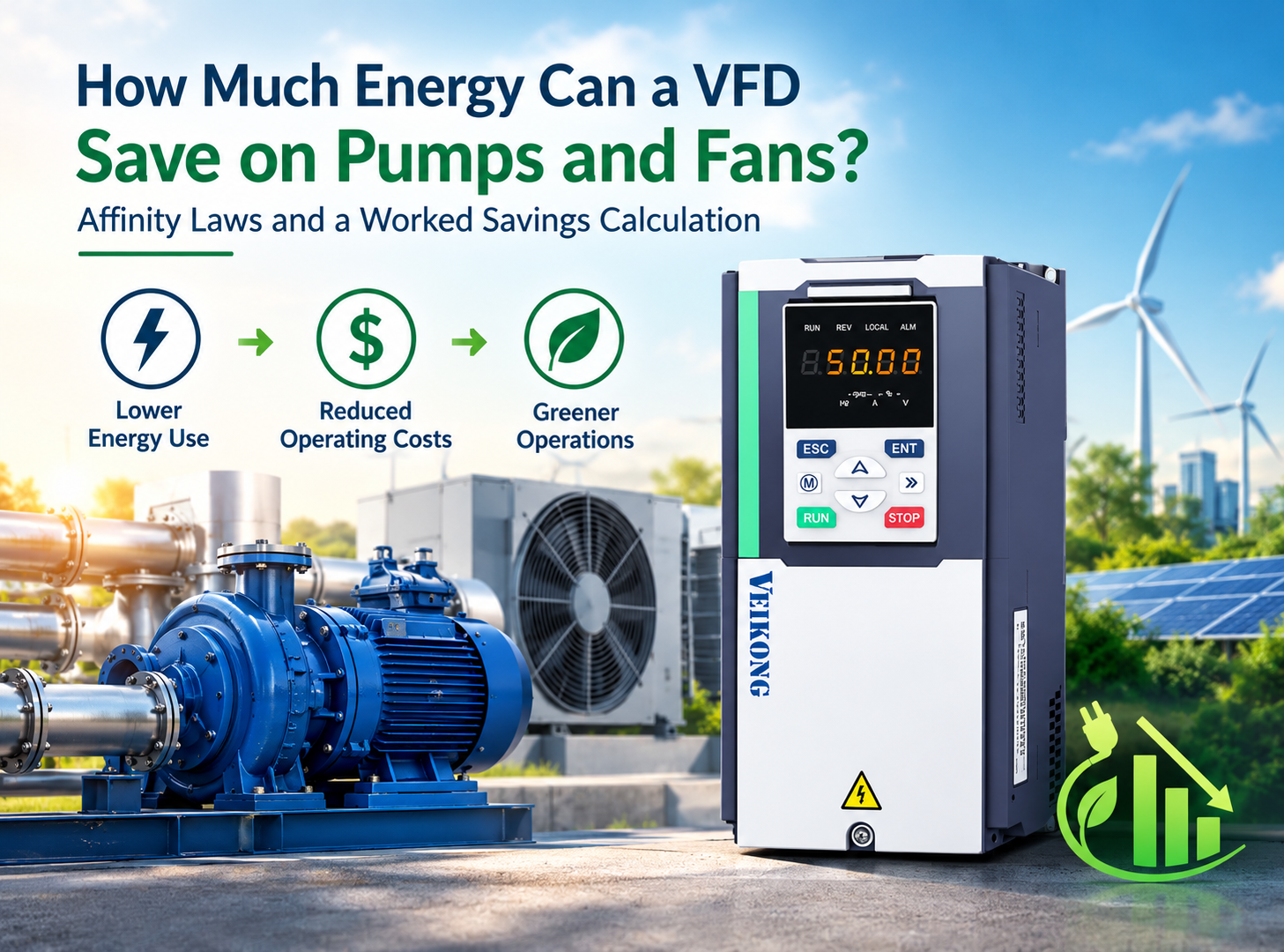
How Much Energy Can a VFD Save on Pumps and Fans? Affinity Laws and a Worked Savings Calculation
Most pumps and fans are sized for the hardest day of the year. The motor is chosen for peak demand, then it spends years on easier days. One boiler plant, for example, ran at about 66% load most of the time. The fan motor still ran at full speed while a damper choked the airflow down to what the boiler needed. The gap between what the machine can deliver and what the process needs is where the electricity goes. A variable frequency drive (VFD) closes it by changing motor speed instead of fighting the flow. This post covers the affinity laws, two worked calculations, and a measured fan retrofit. The Short Answer How much energy can a VFD save on a pump or fan? It depends on how the machine is loaded, but the numbers can be large. What the Affinity Laws Say The affinity laws describe how a pump or fan responds when its speed changes. They apply to pumps just as they do to fans. Three links matter: The third link drives the savings. Slow a pump a little and power drops a lot, which is why a VFD can cut energy use by more than the speed change alone would suggest. Why Valves and Dampers Waste Energy Throttling changes flow but leaves motor speed alone. Here is how common setups behave: A VFD slows the pump instead. The same reduced flow is reached at lower pressure. Lower pressure can mean longer pump seal life, less impeller wear, and less vibration and noise. Worked Example One: A Pump Slowed from 1200 to 700 GPM Take a hydronic pump that must drop from 1200 GPM to 700 GPM. Those are the flow figures VEIKONG uses in its pump guidance. The steps look like this: Treat 80% as the best case, because it assumes little or no static head. Static head is the height the pump must lift the water, regardless of the flow. When it is high, the system curve moves toward constant pressure and the savings shrink. The lower the static head, the greater the savings. Worked Example Two: A Boiler Fan Retrofit with Measured Results One VEIKONG oil industry application covers an energy-saving retrofit at a Chinese oil industry company. The plant had six boilers, each with ID, FD, and SA fans. The motors were sized for maximum load, yet the boilers mostly ran at 66% load, and dampers controlled the air. In May 2006, the three fans of the 4# boiler were converted to variable frequency control. Each drive ran one fan motor, and a bypass circuit let the motor run directly on line during drive downtime or maintenance. The measured yearly results: The arithmetic is short. Subtract the after figure from the before figure to get kWh saved. Divide that by the before figure for the saving rate. Multiply the kWh saved by the power price for the money saved. Load changed the result. At 140 t/h of steam flow, the three fans drew about 1,273 kW less than before. At 200 t/h, the gap was about 905 kW. The boiler ran at 140 to 150 t/h for around eight months of the year and at 200 t/h for just two, so the bigger savings landed in the long months. Other gains came with it: What Decides Your Own Savings Three things shape the result: To judge a pump, you need its curves. Pump curves come from the manufacturer. System curves are harder to get, but a quick method gives a fair estimate: VEIKONG Drives for Pump and Fan Control Shenzhen VEIKONG Electric Co., Ltd has researched, manufactured, and traded high-, medium-, and low-voltage frequency inverters since 2004. Several products suit pump and fan work: VEIKONG products follow ISO9001 quality management and meet ISO, CE, and IEC standards. Each unit passes a 12-hour power-on aging test in a high-temperature chamber and a final full-load test before delivery. Summary and Next Steps with VEIKONG Power follows the cube of speed, so a modest speed cut brings a large power cut. The pump example reaches a best case near 80%. The boiler fan retrofit measured 49.5% and paid for itself within the year. Valves, dampers, and bypass lines throw that potential away. Your own number depends on part-load hours, static head, and how flow is controlled today. Send VEIKONG your motor data, flow range, and current control method. The team offers free professional product selection based on your application.