Veikong Electric

Author: Veikong Electric

VFD inverter

VEIKONG Announces Rescheduling of Middle East Energy Dubai 2026

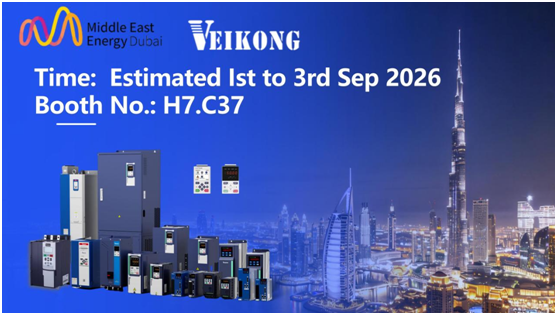
Dubai, UAE Due to the ongoing conflicts and unstable situation in the Middle East, the organizers of the Middle East Energy Dubai 2026 exhibition have officially announced that the event will be rescheduled. The exhibition will now take place from September 1st to 3rd, 2026, at the Dubai World Trade Centre. VEIKONG, a seasoned Chinese manufacturer specializing in industrial automation and power conversion, confirms its participation on the new dates. We will still be located at Booth H7.C37, ready to welcome attendees, distributors, and industry partners from across the region. What to Expect in September While the dates have changed, our excitement for meeting you in Dubai has only grown. Looking ahead to September, we look forward to sharing more new products and solutions with everyone. Our R&D team has been working on several exciting updates, and the rescheduled exhibition gives us the opportunity to bring even more innovations to showcase—products designed to address the evolving needs of the Middle East’s industrial and infrastructure sectors. What We’ll Be Showcasing Visitors to our booth can still explore our core lineup: – Industrial AC Drives – Advanced control technology for optimized motor performance and energy efficiency – Servo Drive Systems – Precision motion control for packaging, textile, and automation applications – Solar Pump Inverters – Renewable energy solutions ideal for agricultural irrigation and remote water supply projects – Smart Automation Solutions – Integrated systems enabling remote monitoring and centralized control Why VEIKONG? With over 10 years of experience in the industrial automation sector, VEIKONG has built a solid reputation for reliability and innovation. We believe in practical solutions that solve real-world problems, backed by rigorous testing and dedicated customer support. Mark Your Calendar – New Dates: September 1–3, 2026 – Location: Dubai World Trade Centre – Booth:H7.C37 We understand that schedule changes can be inconvenient, but we truly look forward to connecting with you in September—and sharing what’s new. Our team will be ready to discuss how VEIKONG’s solutions can address your operational challenges, whether you’re looking to reduce energy costs, improve system reliability, or upgrade aging equipment. For inquiries or to schedule a meeting during the rescheduled show, please contact us directly. About VEIKONG: VEIKONG is a Chinese manufacturer specializing in general-purpose inverters, servo drives, and automation solutions. With over 10 years of industry experience, we are dedicated to providing reliable, innovative products that help our customers work smarter and more efficiently. Stay tuned for further updates as we approach the new dates.

Read More »
VFD

A Guide to VFD Installation: Avoid These Pitfalls to Maximize Lifespan

Variable Frequency Drives (VFDs) are the heart of modern motor control systems, delivering energy savings and precise speed regulation. However, even the highest-quality VFD can suffer premature failure if installation details are overlooked. At VEIKONG, we engineer our VFDs for reliability, but proper installation is the key to unlocking their full lifespan. This guide walks you through the most common installation pitfalls and how to avoid them. The installation environment directly impacts VFD longevity. Many users underestimate how critical this is.  The “Sauna” Effect: Temperature Control The Pitfall: Installing VFDs in high-temperature environments without adequate ventilation. Why It Matters: Temperature is the single biggest factor affecting electronic component life. For every 10°C rise in ambient temperature, the lifespan of a VFD’s electrolytic capacitors is cut in half. Most VEIKONG VFDs are rated for operation up to 50°C without derating. Beyond that, you must either derate the unit or provide forced cooling.                        The Fix: – Ensure at least 10cm of clearance on top and bottom for proper airflow – Install cooling fans or air conditioning in enclosed cabinets – For IP55-rated VEIKONG VFD510 series units, the sealed design protects against dust but still requires adequate heat dissipation  Dust, Oil, and Moisture The Pitfall: Exposing VFDs to harsh environments without proper protection. Why It Matters: Dust accumulation acts as insulation, trapping heat. Conductive dust can cause short circuits. Moisture leads to corrosion, contact issues, and insulation breakdown. The Fix: – For dusty or oily environments, choose IP55-rated units like the VEIKONG VFD510 series, specifically designed for such conditions – If using standard IP20 units, install them in a clean, sealed cabinet – Regularly clean filters and inspect for dust buildup  Vibration The Pitfall: Mounting VFDs on vibrating equipment like punch presses or industrial washing machines without isolation. Why It Matters: Vibration is a primary cause of mechanical damage to electronic components. Loose terminal screws from vibration are often the culprit behind module failures. The Fix: – Use rubber vibration dampers or isolation mounts – Regularly torque main circuit connections (refer to VEIKONG manual for torque specifications) – Avoid mounting directly on heavy vibrating machinery  Proper wiring is non-negotiable. A seemingly minor error can destroy your VFD instantly.  Input vs. Output: Never Confuse Them The Pitfall: Connecting input power to output terminals (U, V, W). Why It Matters: This is catastrophic. Applying AC power to the output terminals will instantly destroy the IGBT module and internal circuitry. The Fix: – Double-check: Input terminals are R/L1, S/L2, T/L3 (or L1, L2, L3) – Output terminals are U, V, W – VEIKONG manuals clearly label these—always verify before powering on  Cable Length and Output Reactors The Pitfall: Running long motor cables without output filtering. Why It Matters: Long cables increase capacitive leakage current, which can cause overcurrent trips, insulation stress, and reflected wave damage to motor windings. The Fix: – < 50 meters: No additional filtering required for most installations – 50–100 meters: Install an output reactor – > 100 meters: Use a sine wave filter and reduce carrier frequency – VEIKONG VFDs support up to 500 meters of shielded cable with proper filtering  Grounding: The Most Overlooked Protection The Pitfall: Improper or missing ground connections. Why It Matters: A real-world case study shows a facility losing over a dozen VFDs simultaneously because a motor leaked current and the facility ground had corroded, sending high voltage back through the VFD ground and destroying main boards. The Fix: – Always connect the VFD ground terminal (PE) to a true earth ground – Use a dedicated ground bus where possible – Verify ground resistance is less than 1Ω for sensitive applications – Do not share ground wires with high-noise equipment like welders  Power Factor Correction Capacitors The Pitfall: Installing power factor correction capacitors on the output side of the VFD. Why It Matters: This is a common but critical error. The VFD’s PWM output will cause capacitors to draw excessive charging currents, leading to immediate overcurrent trips or catastrophic failure. The Fix: – Install power factor correction on the input side of the VFD only – Use AC reactors for power factor improvement when needed  Circuit Breaker (MCCB) Selection The Pitfall: Using an undersized or oversized circuit breaker. Why It Matters: Without proper short-circuit protection, a module failure can cascade into a full board replacement. Conversely, a breaker that’s too sensitive will nuisance trip. The Fix: – Follow VEIKONG’s recommended MCCB and contactor ratings – Example: For VFD510-2R2-T4B, use a 10A MCCB and 0.75mm² conductor – Always include a circuit breaker on the input side  Braking Resistor Wiring The Pitfall: Connecting the braking resistor directly to the DC bus terminals (+/PB or +/-) incorrectly. Why It Matters: Miswiring can cause fire or drive damage. The Fix: – Connect braking resistor to the designated terminals (typically (+) and PB) – Never connect the braking resistor directly between DC bus (+) and (-)—this bypasses the braking transistor – For VEIKONG VFD510 series, refer to the wiring diagram in Chapter 3 of the manual Installation isn’t just physical—parameter configuration is part of the setup.  Acceleration/Deceleration Time The Pitfall: Setting acceleration or deceleration times too short for the load. Why It Matters: Too short an acceleration time causes overcurrent trips. Too short a deceleration time without a braking resistor causes overvoltage trips as regenerative energy pumps up the DC bus. The Fix: – Start with longer times (e.g., 20–30 seconds) and gradually reduce – For high-inertia loads, use a braking resistor or extend decel time – Adjust based on actual operation, not theoretical calculations  Motor Parameters The Pitfall: Not entering correct motor nameplate data. Why It Matters: Vector control relies on accurate motor parameters. Incorrect values lead to poor torque control, instability, or overcurrent issues. The Fix: – Enter motor rated current, voltage, frequency, and speed from the nameplate – Perform motor auto-tuning (static or dynamic) for optimal performance – VEIKONG VFDs support both static and dynamic tuning for precise control  Cooling

Read More »
VFD

How to Choose the Right VFD Capacity for Your Motor? A Sizing Guide

Selecting the correct Variable Frequency Drive (VFD) capacity is critical for ensuring optimal motor performance, energy efficiency, and equipment longevity. An undersized VFD may cause frequent overload trips or premature failure, while an oversized unit leads to unnecessary capital expenditure. At VEIKONG, we specialize in providing high-performance VFDs tailored to your application needs. This guide walks you through the key considerations for VFD sizing. Before selecting a VFD, identify your motor load characteristics: – Constant Torque Loads: Conveyors, cranes, extruders, and positive displacement pumps. These require consistent torque across the speed range. For these applications, the VFD must be selected based on the motor’s rated current with a 150% overload capacity for 60 seconds (typical for VEIKONG VFD500/VFD580 series) . – Variable Torque Loads: Centrifugal fans, pumps, and blowers. Torque increases with the square of speed. For these, a VFD with 120% overload capacity for 60 seconds is often sufficient, allowing for potential downsizing compared to constant torque applications . – Constant Power Loads: Machine tools, winders. These require special attention as torque decreases when speed increases. A common mistake is sizing a VFD solely by motor power rating (kW/HP). The golden rule is to use current (Amps) as the primary selection criterion. The VFD’s rated output current must meet or exceed the motor’s full load current (FLC). Since VFDs introduce harmonics and voltage spikes, it is recommended to apply a safety factor of 1.05 to 1.1 . Example: A 7.5kW motor with a rated current of 17A would require a VFD rated for at least 18.7A (17A × 1.1). Refer to the VEIKONG VFD580 series data where the 7.5kW model delivers 17.0A—perfectly suited, while moving up to 11kW ensures extra headroom . Environmental factors significantly impact VFD capacity – Temperature: VEIKONG VFDs are rated for operation up to 40°C without derating. For every 1°C above 40°C (up to 50°C max), the rated output current must be reduced by 1.5% . – Altitude: At altitudes above 1000 meters, air density decreases, reducing cooling efficiency. Derate the VFD by 1% for every additional 100 meters above 1000m . If your installation site is hot or high-altitude, select a VFD one size larger than standard calculations. High-inertia loads (e.g., fans with large blades, flywheels) demand high starting torque. While VEIKONG’s sensorless vector control (SVC) provides 180% starting torque at 0.25Hz, you must ensure the VFD’s short-term overload capacity can handle the startup surge . For applications requiring frequent starts and stops, calculate the root mean square (RMS) current over the duty cycle. Use the formula: I_RMS = √[(I₁²t₁ + I₂²t₂ + … + Iₙ²tₙ) / (t₁ + t₂ + … + tₙ)] The VFD’s rated current should exceed this RMS value . If one VFD drives multiple motors: – Ensure the VFD’s rated current is ≥ the sum of all motor FLCs . – Operate in V/F control mode (not vector control) . – Install individual thermal overload protection for each motor. – For the VEIKONG VFD500 series, this configuration works well for textile or packaging lines where synchronous speed is required. Long motor cables increase capacitive leakage current, which can cause VFD overcurrent or damage. – For cable lengths >50 meters, install an output reactor. – For lengths >100 meters, use a sine wave filter and reduce the carrier frequency . – VEIKONG VFDs support up to 500 meters of shielded cable with proper filtering.  Conclusion Proper VFD sizing is a balance of current capacity, load characteristics, and environmental conditions. By focusing on motor full load current rather than power alone, and accounting for derating factors, you can ensure reliable and efficient motor control. Need help selecting the right VFD? Contact VEIKONG’s technical support team with your motor nameplate details and application description. We’ll provide a precise recommendation within 24 hours.

Read More »
VFD

Does Your Equipment Need a VFD? 5 Key Signs to Look For

In today’s industrial automation landscape, the efficiency and reliability of motor control systems directly impact production costs and product quality. As a professional VFD (Variable-frequency Drive) manufacturer, VEIKONG understands that choosing the right drive solution is crucial. A VFD not only precisely controls motor speed but also significantly saves energy and extends equipment life. Is your equipment ready for an upgrade? Here are five key signs indicating it’s time to consider equipping your machinery with a VEIKONG VFD. If you notice consistently high monthly electricity bills—especially for equipment like fans and pumps that run for long periods—it usually means the motors are running at full speed, causing significant energy waste. According to the laws of fluid mechanics (Affinity Laws), when the flow rate is reduced by 20%, reducing the speed with a VFD can theoretically cut energy consumption by nearly 50%. By optimizing motor output power, a VEIKONG VFD can directly save this excess electricity, typically offering a payback period of less than one year. When large motors are started directly (Direct-On-Line starting), they can generate inrush currents 4 to 7 times their rated current. This not only puts immense stress on the power grid, causing voltage dips, but also severely impacts the motor windings and gearbox. VEIKONG VFDs provide a soft-start function, allowing the motor to accelerate smoothly from zero to the set speed, completely eliminating current spikes, protecting the grid, and reducing mechanical wear. In many production lines, product consistency is a core requirement. If your equipment cannot precisely control the speed of a conveyor belt, the rotation of a mixer, or the pressure of a pump—resulting in inconsistent product quality—this is a clear signal. VEIKONG VFDs support high-precision closed-loop control, capable of fine-tuning motor speed in real-time based on sensor signals, ensuring the production process always remains optimal. Mechanical failures often stem from excessive stress and wear. Every start, stop, or sudden speed change of a motor impacts bearings, belts, and gears. If you find that belts break frequently or bearings need constant replacement, introducing a VFD enables smooth, stepless speed regulation, reducing transient stresses. Additionally, the built-in motor protection functions in VEIKONG VFDs (such as overload, over-voltage, and under-voltage protection) can provide early warnings, prevent motor burnout, and significantly reduce downtime. Modern production lines often involve multiple motors working in coordination. If your line experiences issues like misalignment, uneven stretching, or material accumulation, it might be because the speeds of the motors cannot be precisely matched. VEIKONG VFDs are equipped with advanced communication functions (such as Modbus, Profibus, etc.), making it easy to build a networked control system that achieves precise synchronization or ratio speed control between multiple motors, enhancing overall line efficiency. Why Choose VEIKONG? Facing these challenges, VEIKONG offers not just a VFD, but a complete drive solution. Our products are designed with a focus on stability and adaptability. Whether in heavy dust environments or situations with significant grid fluctuations, VEIKONG VFDs operate reliably. We are committed to helping every customer achieve energy savings and increased efficiency through leading power electronics technology and localized, responsive service. If you notice any of the above signs in your equipment, please do not ignore it. Contact VEIKONG and let our technical experts customize the most efficient drive upgrade solution for you.

Read More »
VFD

Precision Lifting Starts Here: Why VFD530 is the Choice for Cranes & Hoists

In the world of material handling, precision and smoothness are non-negotiable. Whether you’re lifting tons of steel or positioning delicate equipment, your VFD must deliver rock-solid control without compromise. The VEIKONG VFD530 High Performance PMSM AC Drive is engineered specifically to meet the rigorous demands of crane and hoist applications—offering positioning accuracy, low-frequency high torque, and safety features that set a new standard in the industry. 1.Low Frequency, High Torque: Heavy Loads Start Smoothly Crane motors demand massive torque at near-zero speed. The VFD530 delivers: – 180% torque at 0.50Hz in V/f mode – 180% torque at 0.25Hz in SVC mode That means no slipping, no jerking, even when starting under full load. Your crane lifts smoothly, safely, and confidently every time. 2.Instant Response: 0.0s Acceleration/Deceleration In busy lifting environments, every second counts. The VFD530 supports acceleration and deceleration as fast as 0.05 seconds in SVC mode—without tripping or stalling. Whether it’s rapid forward/reverse cycling or emergency stops, your equipment responds instantly and reliably. 3.Smooth Start While Spinning: Speed Tracking That Works Power interruption mid-lift? No problem. The VFD530’s advanced speed tracking function synchronizes with a still-spinning motor and restarts smoothly—no impact, no delay. This feature is a game-changer for crane operations where uptime and safety are critical. 4.One Drive, Multiple Motors: Induction & Synchronous Compatibility The VFD530 isn’t just for one type of motor. It drives: – Induction motors – IPM and SPM synchronous motors With high-performance open and closed-loop vector control, the same drive handles different motor types—reducing spare parts inventory and increasing design flexibility for crane manufacturers. 5.Built-in Logic, No Extra Hardware Complex crane controls often require external relays and timers. Not anymore. The VFD530 includes: – 6 delay function sets – 4 comparator units – 4 logic units These modules work together to create custom control sequences—like multi-speed lifting or limit switching—without any additional hardware. 6.10-Year Design Life, 24-Month Guarantee Reliability is everything in heavy industry. The VFD530 is built with premium-grade components—fans, capacitors, IGBTs—all selected for a 10-year maintenance-free design life*. And we back it with a full 24-month quality guarantee. If something goes wrong, we provide free repair parts with just an error report. Continuous operation at 80% load, 40°C ambient 7.STO Safe Torque Off: Protect People and Equipment Safety first. The VFD530 includes STO (Safe Torque Off) as standard, instantly cutting torque in emergency situations. Ideal for crane maintenance zones and automated lifting lines where personnel safety is paramount. 8.Fire Mode: When Stopping Is Not an Option In a fire or emergency, some equipment must keep running. The VFD530’s Fire Mode overrides standard protection—keeping fans, exhausts, and critical lifts operational even during alarms. This could mean the difference between safe evacuation and disaster. Talk to Any Network: Modbus, Profinet, TCP/IP The VFD530 speaks your language. Standard features include: – Modbus RS485 – TCP/IP protocol for secure, high-speed data transfer – Optional Profinet and Canopen cards 9.Save Energy While Lifting Even heavy lifting can be energy-efficient. The VFD530’s automatic energy-saving function adjusts operation when conditions allow—cutting power consumption without sacrificing performance. Perfect for green building certifications and long-term operational savings. 10.Need Something Special? We Build It Every crane application is unique. That’s why VEIKONG offers non-standard software custom development. Whether it’s a specialized control algorithm or a unique interface, we help you stand out in your market with tailor-made solutions. VEIKONG: Your Trusted Supplier for High-Performance Lifting Solutions

Read More »
Veikong VFD

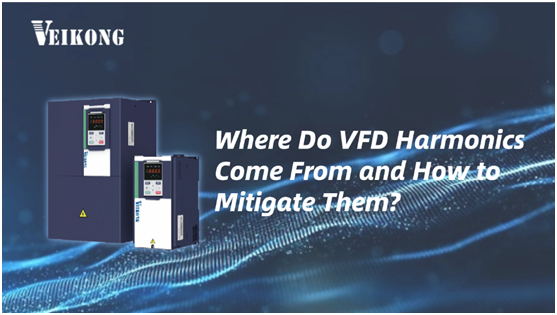
Where Do VFD Harmonics Come From and How to Mitigate them?

In modern industrial automation, Variable Frequency Drives (VFDs) are essential for energy saving and precise motor control across countless applications. From conveyors and pumps to fans and compressors, VFDs regulate motor speed by varying the frequency and voltage of input power. However, despite their operational benefits, VFDs come with an inherent electrical challenge: harmonic distortion. As non-linear loads, VFDs do not draw current smoothly from the power grid. Instead, they draw current in short pulses, which introduces harmonic currents into the electrical system. These harmonics are distorted waveforms that superimpose on the fundamental frequency (50Hz or 60Hz), leading to power quality issues, increased losses, and potential equipment malfunction. At VEIKONG, we believe that understanding these distortions is the first step toward building a more efficient and reliable power system for your facility. So, where exactly do these harmonics originate? To understand this, we need to look inside a typical VFD, such as the VEIKONG VFD series. The front end of most VFDs consists of a diode bridge rectifier that converts incoming AC voltage into DC voltage. This rectifier only conducts current when the instantaneous AC line voltage exceeds the voltage across the DC bus capacitors—which occurs only near the peak of the voltage waveform. As a result, the input current is not a smooth sine wave but rather a series of narrow, high-amplitude current pulses. According to Fourier analysis, these pulses are composed of the fundamental frequency and a spectrum of higher frequencies called harmonics. In a standard six-pulse rectifier, the characteristic harmonics are typically the 5th, 7th, 11th, and 13th order. Their cumulative effect can be severely disruptive to the entire electrical distribution network. Harmonics are not merely a theoretical concern; they have very real consequences for industrial operations. When harmonic currents flow through the electrical system, they can cause a cascade of operational issues. Common symptoms include overheating of transformers and neutral conductors due to increased losses, nuisance tripping of circuit breakers that cannot distinguish between harmonics and fault currents, and premature failure of power factor correction capacitors. For the motor itself—the very equipment the VFD is meant to control—harmonics can cause torque pulsations, increased noise, and additional heat generation, all of which reduce motor efficiency and shorten its operational lifespan. At VEIKONG, our engineering team rigorously tests every drive to ensure advanced design features that minimize these disturbances, protecting your downstream equipment and ensuring uninterrupted production. Mitigating harmonics effectively begins with good system design and the selection of appropriate components. For many applications, sophisticated filtering may not be immediately necessary; simpler, cost-effective measures can provide substantial improvement. The most common and straightforward method is to install a 3% or 5% AC line reactor on the input side of the VFD. This reactor increases the source impedance, smoothing out the sharp current pulses drawn by the rectifier and significantly reducing the total harmonic current distortion. Another effective approach is the use of DC chokes installed between the rectifier and the DC bus capacitors. Many VEIKONG drives come equipped with built-in DC chokes as standard, or offer optional external reactors, providing a compact and economical first line of defense against harmonics while also offering protection against input power surges. For facilities with sensitive equipment or high concentrations of VFD loads, basic reactors may not be sufficient to bring harmonic distortion down to acceptable levels. In such cases, more advanced mitigation technologies are required. Passive harmonic filters, tuned to trap specific harmonic frequencies (typically the 5th and 7th), can be installed to provide a low-impedance path for those currents. Alternatively, Active Harmonic Filters (AHF) offer a more dynamic solution; they sense harmonic distortion in real-time and inject equal-but-opposite currents to actively cancel out harmonics across a wide frequency spectrum. For renewable energy applications, such as our VEIKONG Solar Pumping Inverters, we utilize advanced MPPT algorithms and optimized switching techniques that inherently produce cleaner power output, ensuring compliance with grid standards while maximizing solar energy harvest from photovoltaic arrays. While discussing VFDs, it is also worth noting the role of other motor control solutions. Across many industrial facilities, VEIKONG Soft Starters are used to control the acceleration of induction motors. Unlike VFDs, soft starters use phase-control thyristors to reduce voltage during startup and then switch to bypass contactors once the motor reaches full speed. During the brief starting period, soft starters can generate some harmonic distortion, although typically less severe than continuous VFD operation. However, because they are bypassed at rated speed, their overall impact on the facility’s long-term harmonic profile is minimal. For applications where speed control is not required but reduced inrush current is desired, VEIKONG soft starters provide an excellent, harmonic-friendly alternative. Understanding where VFD harmonics come from and knowing how to mitigate them is crucial knowledge for any plant manager or engineer. Whether you are using a standard VFD for conveyor control, deploying a soft starter for large pump motors, or integrating a specialized inverter for solar pumping, harmonic management is key to ensuring system longevity and operational reliability. At VEIKONG, we do not simply sell products; we provide complete drive solutions and technical expertise. Our extensive range of VFDs, soft starters, and solar inverters are engineered with harmonic mitigation as a core design principle, helping our customers worldwide achieve greener, more stable, and more efficient industrial operations. Visit our product page or contact our technical team today to find the right solution tailored to your specific application needs.

Read More »
VFD

Special VFDs: Intelligent Variable Frequency Drives Designed for Demanding Industrial Applications

As industries get more specialized and focused on performance, standard variable frequency drives (VFDs) just aren’t cutting it for every operational challenge anymore. That’s where Special VFDs come in. These drives are tailored for specific industries and applications, providing better control, greater reliability, and functions that can really boost efficiency and extend equipment life. Special VFDs are designed to meet unique industrial needs, offering precision, stability, and smart automation where regular drives might not make the grade. What Are Special VFDs? In simple terms, Special VFDs are application-specific variable frequency drives made to cater to the operational demands of certain industries, machines, or environments. They are widely used in applications such as: Unlike the general-purpose VFDs, these drives come with custom control algorithms, special protection features, and optimized hardware tailored for specific tasks. Why Special VFDs Matter in Modern Industry Industrial equipment usually has to deal with tough conditions, fluctuating loads, and high performance standards. That’s where specialized VFDs step in to tackle these issues by providing certain advantages: These specialized VFDs have control logic built right in that’s customized for specific machines. For instance, hoisting VFDs include sophisticated torque control and brake logic, whereas compressor VFDs focus on maintaining pressure stability and boosting energy efficiency. This all helps in achieving smoother operations, greater process accuracy, and less mechanical strain. Industrial motors represent a significant investment. To protect these valuable assets, specialized VFDs come equipped with a range of protective features like: All of these elements play a big role in lengthening the lifespan of motors and cutting down on unexpected downtime. Some industrial setups, like cranes, mixers, and extruders, really need robust torque at low speeds. The special VFDs from Veikong Electric utilize advanced vector control and torque-boost technology to ensure reliable performance, even when operating at zero or near-zero speeds. By precisely matching motor speed to actual load demand, special VFDs reduce energy waste. This leads to: Over time, these savings translate into a faster return on investment (ROI). Key Features of Veikong Electric Special VFDs Veikong Electric’s special VFD solutions stand out due to their intelligent design and industrial-grade reliability: Customized firmware for specific applications ensures precise speed, torque, and position control. Built to withstand dust, vibration, temperature fluctuations, and continuous operation. Support for Modbus, RS485, CANopen, and other industrial protocols allows seamless integration with PLCs, HMIs, and automation systems. Clear parameter structure, intuitive displays, and quick commissioning macros simplify setup and maintenance. Industries That Benefit from Special VFDs Special VFDs are ideal for industries that demand precision and reliability, including: By choosing the right application-specific VFD, businesses can achieve higher productivity while minimizing operational risks. How to Choose the Right Special VFD? Before selecting a special VFD, consider the following: Teaming up with a seasoned manufacturer like Veikong Electric means you’ll get expert advice and a customized solution that fits your needs perfectly. Conclusion: Smarter Control with Special VFDs In the tough industrial scene we’re in today, being efficient, reliable, and precise is key. Special VFDs offer a clever way to manage complex machinery, all while cutting back on energy use and helping your equipment last longer. With a strong emphasis on innovation and practical design, Veikong Electric provides special VFD solutions that help industries work smarter, safer, and in a more sustainable way. If you need a VFD tailored for your particular industrial issue, Veikong Electric’s Special VFDs are definitely the way to go.

Read More »
VFD Solar pump

Things to Know Before Selecting a Solar Pump Inverter for Industrial Use

With the rise of sustainable energy and smart automation in industries, solar-powered water pumps are really making waves, especially for sectors that depend on large water supplies, like irrigation and operations at remote locations. At the core of a well-functioning solar water pumping system is a key player: the solar pump inverter. Picking the right inverter is crucial. It can really impact whether your system runs smoothly and efficiently or ends up being costly and inconsistent. What Is a Solar Pump Inverter? A solar pump inverter, sometimes referred to as a solar variable frequency drive (VFD), is an intelligent power converter that takes the direct current (DC) from solar panels and transforms it into controlled alternating current (AC) to drive industrial water pumps. Unlike conventional inverters, these devices adapt output frequency dynamically based on sunlight intensity, maximizing pump performance even under fluctuating solar conditions. Key Industrial Considerations Before Choosing an Inverter When it comes to solar setups, Maximum Power Point Tracking (MPPT) is something you definitely want to pay attention to. These MPPT algorithms work by continuously adjusting the inverter’s input to pull the most power from solar panels, which is especially useful when lighting conditions change. Top-notch industrial inverters can hit ultra-high MPPT efficiencies, often over 99%. This means you’re getting the most energy you can out of your solar setup, leading to better water output. Why It Matters: When your MPPT efficiency is high, your system can pump more water using the same solar array. This is super important for large irrigation projects, cooling systems in industrial settings, and community water supplies. For industrial uses, you’ll find a variety of power ratings. You might need small 2 kW systems for mid-sized operations, or much larger inverters that can handle hundreds of kW for extensive pumping systems. It’s crucial to make sure your inverter meets the power requirements of your pump motor, and can accommodate any future growth. Pro Tip: To keep things running smoothly, align your inverter rating with your solar array and pump motor. This will help you avoid any inefficiencies Top industrial inverter systems include hybrid AC/DC input support. This means if solar power dips (e.g., cloud cover), the system can automatically switch to grid or generator power to prevent downtime. Hybrid inputs maximize uptime and reliability, especially vital for industrial water systems where continuity is non-negotiable. Important Functional Features for Industrial Environments Solar pump inverters automatically adjust output frequency and voltage in real time based on sunlight and demand. This variable speed control improves efficiency, extends equipment life, and protects against mechanical stress. Industrial pumping systems must be dependable. Choose inverters equipped with comprehensive protection features such as: These protect both the pump and the inverter, reducing downtime and expensive maintenance calls. With options like GPRS, Wi-Fi, and cellular access, you can keep an eye on things and manage operations from a distance. This means industrial operators can check performance metrics, get alerts, and adjust without needing to be physically present. It’s particularly useful for large facilities or industries that operate off the grid. Environment & Durability: Industrial Must-Haves Equipment in industrial environments faces tough conditions, whether it’s dusty fields or wet coastal areas. So, when you’re looking around, consider these: Return on Investment (ROI) Switching from diesel or grid-dependent pumps to solar inverter-driven systems delivers: Industrial users often notice that advanced pump inverters can pay for themselves thanks to better efficiency and lower maintenance costs. Final Thoughts: Make the Smart Choice When you’re picking a solar pump inverter for industrial use, it’s not just about the power ratings or how it performs. You really need to consider how reliable, adaptable, and efficient it is for what you specifically need in your operation. Whether you’re running extensive irrigation systems, overseeing water treatment processes, or supplying power to remote industrial locations, it’s essential to invest in an inverter that can grow with you, offers smart control options, and provides value over the long haul. Check out Veikong Electric’s solar pump inverter products. They’re designed to fit a variety of industrial needs with features like intelligent MPPT control, strong protection mechanisms, flexible hybrid power options, and global support.

Read More »
VFD Solar pump

Top 7 Benefits of Using a VFD for Single to Three Phase Conversion in Motors and Machinery

Modern industries often face a common power challenge. Many small workshops and factories only have single-phase power. Yet, most heavy-duty motors and machines require a three-phase supply. This is where VFD single to three phase solutions become very useful. A Variable Frequency Drive (VFD) converts single-phase power to three-phase and improves motor performance. It also offers flexibility, efficiency, and cost savings. Here are the top seven benefits of using a VFD for single to three-phase conversion in motors and machinery. 1. Simple Power Conversion The primary purpose of a VFD is to permit a three-phase motor to run on a single-phase supply. This is very useful for small businesses and locations where a three-phase supply is not available. Instead of rewiring and possibly altering the electrical supply system, a VFD is used, and a stable supply of three-phase current is obtained directly from a single-phase supply. 2. Smooth Start and Stop Motors connected to the VFD directly may draw high currents. This may damage the motor over time. They also provide the features of soft start and soft stop. Benefits include: Smooth operation will also protect belts, gears, and associated machines. It will also ensure less downtime with machines. 3. Energy Efficiency The most common phenomenon is that motors operate at full speed even if not in use. VFDs provide the ability to control speed in relation to the demand for loads. Examples: This helps save energy and reduces expenditure on electrical bills. 4. Precise Speed Control At times, some machines require variation in speed, and for functioning efficiently, the speed change can be achieved using a device known as the VFD, without having to change. Advantages: Industries such as CNC machining, packaging, and textiles require precise control, and this leads to good results with less waste. 5. Motor Protection A VFD protects motors from electrical faults. The modern drives are fitted with the following built-in safety features: These features cut down the risk of failure of a motor and raise its reliability. 6. Compact, Cost-Effective It is very expensive to install three-phase power lines. This may involve rewiring and approvals. A VFD is smaller, easier, and cheaper to install. Many units are plug-and-play. For this, in a small business, three-phase motors can be run without any major infrastructural changes. In addition, this will save money and time. 7. Versatility VFDs can operate with a variety of motors and machinery. They find broad applications in: One can also use one VFD for multiple applications, which is an intelligent investment for growing businesses. Choosing the Right VFD Performance depends on quality. A robust VFD assures a stable output and long service life. Watch out for features like: A good VFD selects and provides smooth power conversion and consistency in performance. Final Thoughts Using a single phase to three phase VFD is a practical solution for running three-phase motors where only single-phase power is available. It saves energy, protects motors, and reduces costs. Benefits like smooth starting, precise speed control, and versatility make it ideal for industrial and small business setups. For dependable and high-quality VFD systems, Shenzhen VEIKONG Electric CO. Ltd. provides solutions that meet modern industrial needs efficiently and reliably.

Read More »
VFD

Comparing Power Savings: Solar Panel VFD vs. Standard Solar Inverter Systems

Picking the right power conversion system is super important these days for getting the most out of renewable energy, saving money, and making sure everything runs well. Solar power setups depend on some pretty advanced tech to turn sunlight into electricity we can actually use. Still, not all systems are created equal. When it comes to solar power, two options you’ll often hear about are Solar Panel VFD systems and Standard Solar Inverter systems. Both change sunlight into power, but how well they work and how much money they save can change a lot based on your specific needs. In this blog, we’ll explain the differences between these two choices, see how they do in typical situations, and figure out which one is better for saving power. That way, you can pick the best setup for your solar power needs. How They Differ in Power Savings and Efficiency? A regular solar inverter’s main job is to turn solar energy into usable electricity as efficiently as it can. It makes sure you get a good, steady stream of power. Better inverters use tech to keep your solar panels working at their best, even when the sun isn’t constant. A solar VFD does even more, especially for systems that use motors. It not only changes the power but also controls the motor’s speed. By adjusting the voltage and frequency to match what the motor needs, it cuts down on wasted power. In simple terms: Solar inverters are great at getting the most energy they can, but solar VFDs are better at controlling both where the energy comes from and how it’s used, which is useful if you have motors or certain appliances. Solar inverters are great at getting the most energy from panels. But usually, they send out that power at a set rate unless they have extra controllers. Solar VFD systems are ideal for times when loads change, like with irrigation pumps, fans, or machines. VFDs can cut down on wasted electricity a lot better than systems that run at one speed. They do this by automatically changing the motor speed to fit what’s needed at the moment. Regular Solar Inverter Systems: Solar inverters make your system better by grabbing as much power as they can with MPPT and giving a clean AC output. This gives you more usable energy and means you don’t have to rely on grid electricity as much. Solar Panel VFD Systems: Besides being good at turning power, VFDs that run on solar power also lower how much power is wasted while running, by matching the load. So, instead of always running things at the same speed, they adjust the motor power to what’s needed. This can cut electricity use for motor-powered systems quite a bit in real life. Solar VFDs can cut energy costs by 60–80% in some off-grid pumping systems when compared to fixed-speed systems. Standard solar inverter systems are usually easier to set up and use. They don’t require a lot of specialized setup and work well with both grid-tied and off-grid systems. Solar VFD inverter systems are more complex since they combine inverter functions with variable frequency control. They are good for motor-driven uses but might be too much for basic home solar power needs that don’t have motors or variable loads. Which System Saves More Power Overall? For general solar electricity generation: A standard solar inverter usually has great efficiency (95–98% conversion, plus MPPT gains) and gets the most usable energy from your panels. It’s the best choice for homes and businesses just wanting renewable power. For systems with motor loads or variable demand: A solar panel VFD system could save more energy long-term. It changes solar energy into a usable form and also manages how devices like pumps, fans, and HVAC systems use that energy. This management leads to more energy savings than a regular inverter can provide. Final Thoughts: A Smart Choice Depends on Your Needs Both technologies have their place in solar power systems: The system that saves the most power isn’t necessarily the one with the best conversion rate. It’s the one that effectively aligns energy production with actual usage.

Read More »

Call Now