
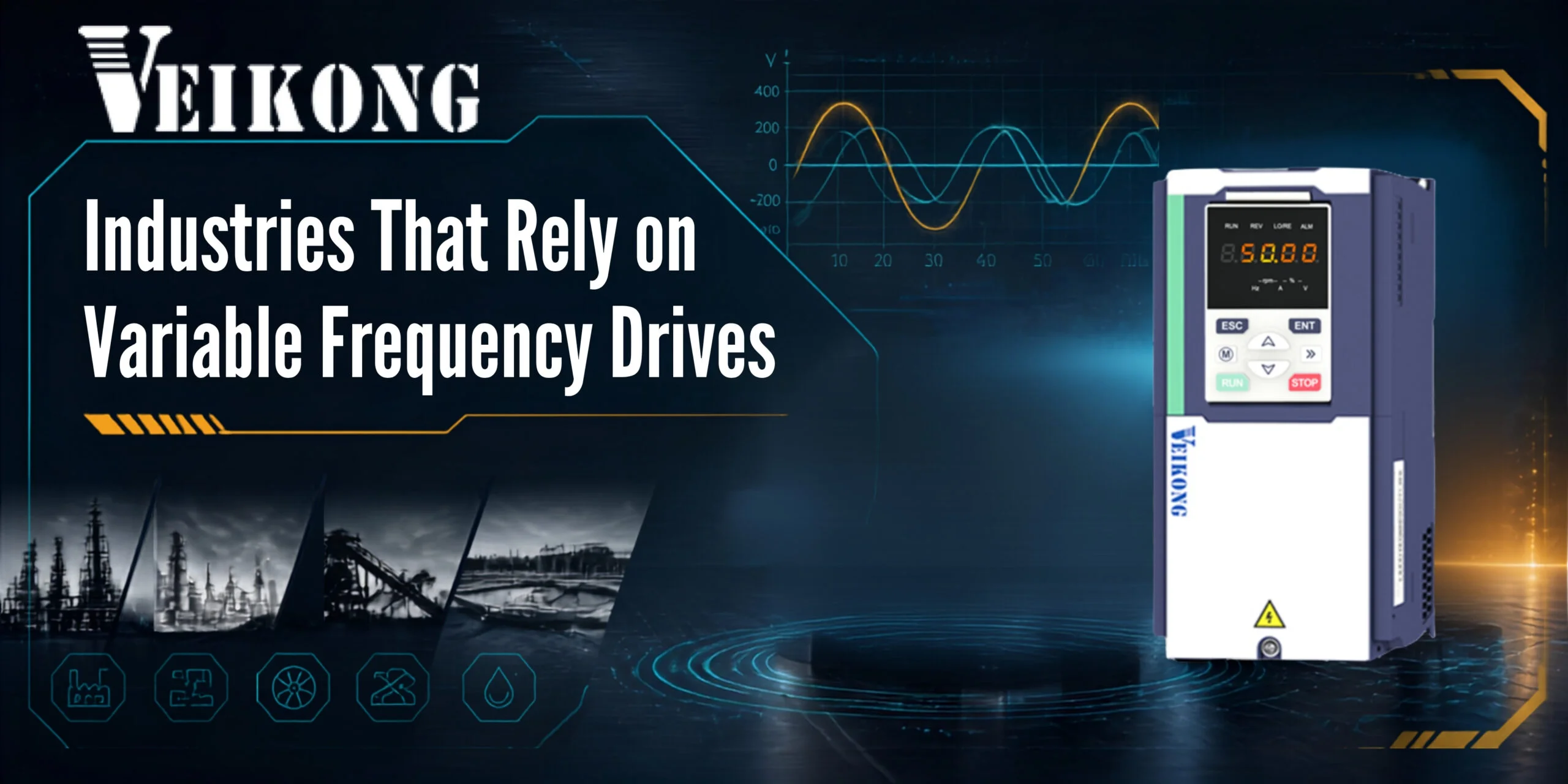
Motors keep industrial operations moving, from pumps and fans to conveyors and mixers. Most of these motors don’t need to run at full speed all the time. That’s where a variable frequency drive, or VFD, becomes useful.
Here’s what it does, in simple terms: a VFD changes the frequency of the electricity going into an AC motor, and that changes how fast the motor spins. Instead of a motor running flat-out whether the job calls for it or not, a VFD adjusts speed to match actual demand on the line.
The result is less wasted energy, less wear on gears and bearings, and considerably more control than a standard on/off switch allows.
So which industries rely on their technology day to day? Quite a few, and often for different reasons. Here is the list of 10 industries that rely on VFDs.
1. Oil and Gas
Boiler fans in oil and gas plants tend to run nonstop; they don’t all need full airflow every hour of the day.
- Fan speed gets matched to real demand instead of sitting at fixed full power around the clock.
- Lower speeds during quieter periods translate into lower electricity bills over months of operation.
- Ramping up gradually, rather than slamming to full speed, spares fan blades and bearings a lot of unnecessary stress.
Retrofitting induced-draft and forced-draft boiler fans with VFDs for energy savings is a fairly standard move in this sector, mostly because these fans log so many operating hours that even small efficiency gains add up fast.
2. Water Supply and Municipal Pumping
Anyone who’s worked with municipal water systems knows demand isn’t flat. It climbs in the morning, drops off overnight, and spikes without warning when something goes wrong elsewhere in the network.
A VFD on a water pump adjusts motor speed to track that actual demand curve, rather than running the pump at one constant rate and throttling a valve to compensate, which simply burns extra power for nothing.
Multi-pump control panels take it further by coordinating several pumps together, rotating which unit carries the load so one motor doesn’t wear out faster than the rest of the fleet.
3. Agriculture and Solar Water Pumping
Out in remote farmland, the power grid often isn’t reliable, or isn’t there at all. Solar-powered water pumps have filled that gap for irrigation and livestock water supply.
- Solar pump inverters take the uneven output from solar panels and turn it into steady, usable motor power.
- Speed adjusts on its own as sunlight strengthens or fades through the day.
- Farmers get consistent water delivery without needing a diesel generator running in the background.
The same setup scales up nicely for bigger water projects too, including irrigation basins and public swimming facilities that need a steady, sizable water supply.
4. Manufacturing and Compressed Air Systems
Compressed air runs half of what happens on a factory floor: tools, packaging equipment, pneumatic controls. And air compressors have a bad habit of wasting energy when they’re built to run at full output, but the plant only needs a fraction of that.
Add a VFD, and the compressor reads pressure from a remote sensor and adjusts motor speed to hold that pressure right where it needs to be. Say a plant needs 0.76 MPa.
The drive keeps things sitting at that number instead of overshooting and venting the excess. That precision alone cuts a surprising amount of wasted energy, and it’s easier on the compressor’s internals too.
5. Material Handling: Hoists and Cranes
Lifting something heavy safely comes down to torque control, and the first few seconds of a lift are usually where things go wrong if they’re going to.
- Hoisting-specific VFDs deliver strong torque even at low speed, right when a load first leaves the ground.
- Controlled acceleration keeps loads from swinging or jerking against the cables.
- Lowering a load into a tight space gets a lot smoother with proper speed control.
Ports, warehouses, and construction sites- anywhere cranes and hoists are working- all lean on this kind of torque and speed management.
6. Plastics and Injection Molding
Most injection molding machines still run on hydraulic power, but the pump behind the hydraulics doesn’t actually need to spin at one fixed speed the whole way through a molding cycle.
Fitting a VFD lets pump speed track each stage separately: fast during mold filling, slower during cooling, adjusted again for ejection. That alone trims electricity use and cuts down on heat buildup in the hydraulic fluid, which means the seals and valves last longer before needing replacement.
7. Plastic Disk Molding
Disk-type plastic molding machines throw sudden, sharp load changes at their motors mid-operation. A standard motor takes that kind of shock poorly, and it shows up as shortened service life.
- A VFD absorbs these load swings by adjusting motor response as they happen, not after the fact.
- Gearboxes and bearings stay protected from repeated mechanical jolts.
- Speed stays consistent enough to actually improve part quality coming off the line.
8. Textiles and Building Materials
Textile mills and building material plants each run a small army of motors, including winders, mixers, extruders, and conveyors, often all at different speeds within the same shift.
VFDs let every motor run at whatever speed its particular job calls for, rather than forcing one fixed rate across an entire production line. In textiles, that means tension stays consistent through the fabric. In cement or brick production, it keeps mixing and extrusion steady and repeatable.
Both industries pick up an added bonus too: lower starting current, since a VFD ramps motors up gradually instead of hitting them with full power right away.
9. Power Generation and Electric Utilities
Power plants and utilities run large fans, pumps, and auxiliary equipment that all need to respond as load conditions shift, sometimes hour to hour.
- Variable-speed auxiliary fans and pumps pull less electricity during low-demand stretches.
- Soft starting takes pressure off the wider grid whenever a motor kicks on.
- Coordinating multiple motors together keeps large facilities running steadily instead of lurching between loads.
10. Home Appliances: Washing Machines
Even the washing machine in a laundry room uses this same principle. A wash cycle isn’t one speed. It runs through several, back to back.
Fill, wash, rinse, and spin each call for a completely different drum speed, and the gentle motion needed for washing has nothing in common with the speed needed for a fast spin-dry.
A variable frequency drive handles the whole cycle with a single motor, adjusting speed as each stage arrives. That’s a far simpler, more efficient approach than building in separate motors or gear assemblies for every stage.
How Veikong Electric Supports Industries with Reliable Variable Frequency Drives
Shenzhen Veikong Electric Co., Ltd. has been building AC drives and VFDs for more than 20 years now, and honestly, its product line touches most of the industries covered above.
- General-purpose AC drives, including the VFD500, VFD530, and VFD580 series, cover standard industrial motor control.
- The VFD500-PV and VFD510 PV solar pump inverters are built for agricultural and remote water-pumping work.
- Soft starters, including the VKS-8000 and VKS-6000 series, give hoists, cranes, and heavy pumps a controlled startup.
The drives themselves run on SPWM and sensorless vector control technology, and the company holds ISO9001 and CE certification across its manufacturing and quality processes.
Veikong describes its products as a direct equivalent to established European, American, and Japanese drive brands, giving buyers a comparable option with technical support behind it.
Choosing the Right VFD for Your Industry
No two industries have quite the same need from a drive. A crane wants strong torque at low speed. A solar pump needs stable output from a source that isn’t stable at all. A textile line wants tight speed consistency across dozens of motors running together.
It really comes down to one question first: what does the load actually demand, moment by moment? Get the answer, and matching torque profile, protection rating, and control features to it gets a lot more straightforward.
If your operation lines up with one of the industries above and you’re weighing VFD options, start by mapping out your motor’s load pattern. Everything else follows from there.
Also Read: How to Use VFD for Converting Single-Phase Power to Three-Phase?