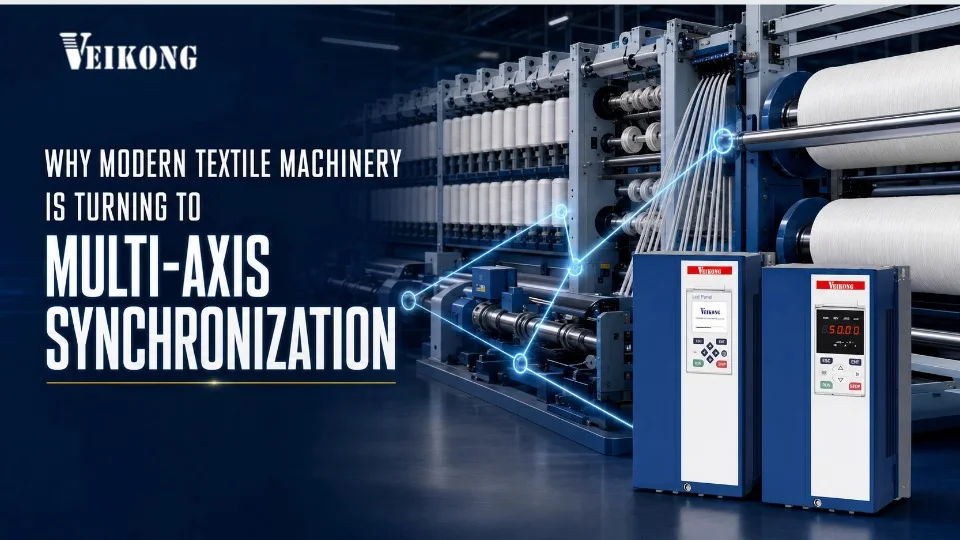
Modern textile manufacturing is moving toward higher production speeds, greater automation, and more flexible processing. As a result, traditional mechanical transmission systems are becoming less suitable for machines that require precise coordination between several moving sections.
Roving machines and warping machines are typical examples. Instead of relying on a single motor, these machines often use several independently driven axes. Each axis performs a different task, but all of them must work together accurately to maintain stable yarn tension and consistent product quality.
In a roving machine, the rollers, flyers, winding mechanism, and lifting system may be driven by separate motors. Their speeds and positions must remain synchronized during acceleration, normal operation, and deceleration. Even a small difference between the axes can affect yarn tension, winding density, and drafting accuracy.
Warping machines face a similar challenge. The tail frames, drawing section, guide rollers, and warping head must maintain a precise operating relationship. If one axis responds too slowly or runs at an inconsistent speed, the yarn may become loose, unevenly wound, or more likely to break.
What Is Multi-Axis Synchronization?
Multi-axis synchronization does not simply mean running several motors at the same frequency. It means coordinating each axis according to a shared speed, position, or torque reference.
Every axis has different mechanical inertia, load characteristics, and transmission ratios. The winding diameter may also change continuously during production. A modern control system must monitor these changes and adjust the motor speed or torque in real time.
High-performance vector control, encoder feedback, and industrial communication networks are commonly used to achieve this level of coordination. These technologies allow multiple drives to exchange operating data and correct synchronization errors quickly.
Dynamic response is particularly important when a textile machine starts or stops. If one axis accelerates faster than the others, yarn tension may suddenly increase. If one axis decelerates too slowly, the yarn may become loose or unevenly wound. A responsive synchronization system helps all axes complete these movements smoothly.
Improving Tension Control and Yarn Quality
Stable tension is one of the most important requirements in textile production. Excessive tension can cause yarn breakage, while insufficient tension can lead to loose winding and inconsistent package density.
Multi-axis synchronization helps maintain the correct relationship between the different machine sections. This improves tension stability and supports more consistent yarn quality throughout the production process.
Better synchronization can also reduce problems during later spinning or weaving stages. When yarn is wound evenly and processed under stable tension, manufacturers can achieve more predictable production results and reduce unnecessary material waste.
Supporting Higher Production Speeds
Textile manufacturers are continually looking for ways to increase output without sacrificing quality. However, higher machine speeds place greater demands on the drive and control system.
The motors must accelerate and decelerate quickly while maintaining synchronization. The system must also respond rapidly to changes in load, winding diameter, and production conditions.
A well-designed multi-axis system can help the machine operate at higher speeds with fewer tension disturbances and less mechanical vibration. It can also improve starting and stopping performance, reducing the time required between production cycles.
Greater Flexibility and Easier Commissioning
Modern textile factories often process different fibers, yarn specifications, and package sizes. Each product may require different speed ratios, tension settings, and operating sequences.
Drive systems with parameter recipes and application macros make it easier to switch between production requirements. Instead of manually adjusting every parameter, machine builders can create predefined settings for different processes.
Online diagnostics, parameter backup, and monitoring functions can also simplify commissioning and maintenance. Engineers can identify operating problems more quickly and restore saved parameters when necessary.
Coordinated Stopping and Fault Management
Synchronization remains important even when the machine is stopping. During a temporary power interruption or a non-critical fault, each axis should follow a coordinated stopping sequence.
If the motors stop independently, yarn may break or the package may be damaged. Power-loss stopping logic can help the axes decelerate according to a predefined relationship, protecting the material and maintaining process stability.
Different fault response levels can also be configured according to production requirements. Some faults may require an immediate stop, while others may allow the machine to continue operating at a reduced level until the process reaches a safe stopping point.
Selecting a Drive System for Textile Machinery
Selecting a drive system involves more than matching the rated motor power. Machine builders should also consider dynamic response, synchronization accuracy, communication capability, encoder compatibility, overload capacity, and environmental reliability.
The system may need to control asynchronous motors, permanent magnet synchronous motors, or servo motors. Support for speed, torque, and position control provides greater flexibility for different machine sections.
Industrial communication is another important consideration. CAN and Modbus can support many synchronization tasks, while EtherCAT is suitable for systems requiring faster real-time communication.
Textile workshops may also contain cotton fibers, dust, and high ambient temperatures. Independent cooling ducts and sufficient thermal design margins can help protect the drive and support reliable long-term operation.
Meeting Modern Textile Control Requirements
The VEIKONG VFD580 and VFD586 series provide sensorless vector control, closed-loop vector control, and speed, torque, and position operating modes. They are compatible with asynchronous motors, permanent magnet synchronous motors, and servo motors.
Both series support CAN and Modbus communication, while the VFD586 also supports EtherCAT real-time communication. These functions allow the drives to be integrated into different multi-axis control architectures.
For roving and warping machine applications, the available solutions include position synchronization, fast start-and-stop response, power-loss stopping logic, and application macro settings. The independent air-duct design and operation without derating at ambient temperatures of up to 50°C also address common conditions in textile workshops.
The final configuration should still be selected according to the number of axes, required synchronization accuracy, encoder type, mechanical structure, and production process.
Multi-axis synchronization is becoming a fundamental technology in modern textile machinery. Its value is not simply in operating several motors at the same time, but in enabling the entire machine to work as one coordinated and stable system.
Also read: Top 7 Benefits of Using a VFD for Single to Three Phase Conversion in Motors and Machinery