
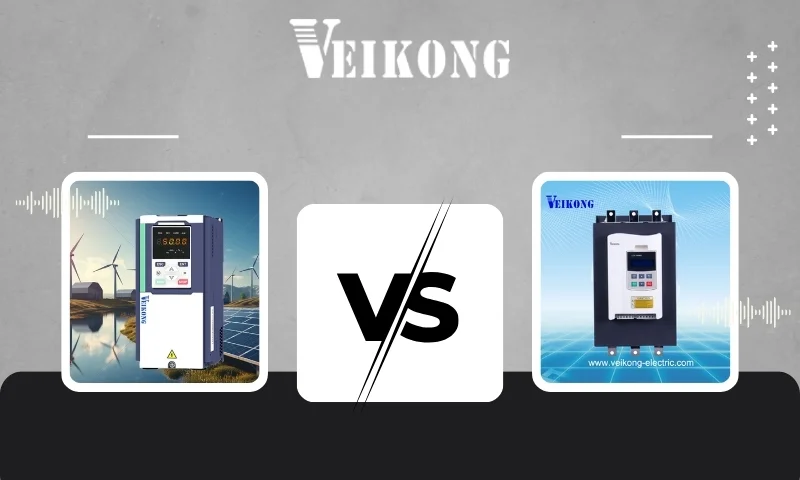
In almost every factory, plant, or industrial facility, motors are running somewhere. They drive pumps, move conveyors, spin fans, and power compressors. And whenever a motor is part of the system, someone eventually has to decide how to control it.
Two devices come up in this conversation more than anything else: the Variable Frequency Drive and the Soft Starter. Both are common. Both are useful. And both get confused with each other far too often.
This guide is for anyone trying to understand the real difference between the two, what each one actually does on the job, and how to pick the right one without overcomplicating the decision.
What Is a Variable Frequency Drive?
A Variable Frequency Drive, or VFD, is a device that controls how fast an AC motor runs by changing the frequency of the electrical supply going into it. More frequency means more speed. Less frequency means less speed. That relationship is what gives a VFD its name.
The key thing about a VFD is that it works throughout the entire time the motor is running, not just at startup. You can set a motor to run at half speed, ramp it up gradually, slow it back down, or run it at full speed depending on what the process needs at any given moment. That level of control is what separates a VFD from most other motor control devices.
Industries that deal with changing loads throughout the day get the most out of VFDs. Water treatment plants adjust pump speeds based on demand. HVAC systems slow fan motors down at night when less airflow is needed.
Manufacturing lines speed up or slow down based on production requirements. In all these cases, running the motor at a lower speed during low-demand periods saves a significant amount of energy.
What a VFD Can Offer?
- Speed control at any point during operation, not just at startup.
- Energy savings that can reach up to 50% in variable load applications.
- Gradual acceleration and deceleration that go easy on mechanical components.
- Motor protection against overcurrent, overvoltage, and thermal overload.
- Consistent output that improves process quality and equipment longevity.
What Is a Soft Starter?
A Soft Starter is a control system used for regulating the voltage input to the electric motor during the starting period.
The current drawn by the electric motor when it is started at full voltage creates stress on the electric motor coils, shakes any mechanical elements connected to it, such as couplings or belts, and even creates problems for the supply side of the grid.
A soft starter makes sure that the voltage input to the electric motor grows gradually, allowing the motor to gain its rotational speed gradually. Once the motor gains the desired speed, the soft starter completes its work. It remains idle until the next start.
In some soft starter designs, the control is done even during stopping the motor, slowing down the motor gradually. This is beneficial in cases of using the soft starters in pumps where abrupt stops create excessive pressure in pipes.
What can a Soft Starter offer?
- Reduced inrush current at startup, which protects the motor and the electrical system.
- Less mechanical shock on gears, belts, couplings, and connected equipment.
- Simpler design that takes up less panel space than a VFD.
- Lower purchase price for applications that do not need speed control.
- Easy installation and setup for fixed-speed systems.
Where People Get Confused
The confusion between VFDs and soft starters usually comes from the fact that both reduce startup stress. That overlap makes people think they are interchangeable. They are not.
A soft starter only handles the start and, in some cases, the stop. Everything in between runs at full speed with no adjustment possible. A VFD handles the start, the stop, and everything in between. If your motor needs to change speed during operation, a soft starter cannot do that regardless of how it is set up.
The other common point of confusion is cost. Soft starters are cheaper upfront and smaller in size. VFDs cost more initially but can recover that cost through lower energy bills over time, particularly in applications where motors run for long hours at partial loads.
How to Pick the Right One
The honest answer is simpler than most people expect. Ask yourself one question: does this motor need to run at different speeds during normal operation?
If the answer is yes, go with a VFD. There is no workaround for variable speed control, and a soft starter will not get you there.
If the answer is no and the motor always runs at full speed once it gets going, a soft starter is the practical choice. It handles the startup smoothly, costs less, takes up less space, and does exactly what the application needs.
How Shenzhen VEIKONG Electric Co., Ltd. Helps You Make the Right Decision
Shenzhen VEIKONG Electric Co., Ltd. has spent over 20 years manufacturing AC drives, VFDs, and soft starters for industrial customers in more than a dozen countries. The company is based in Baoan District, Shenzhen, China, and is recognized as one of the first independent AC drive companies in China.
VEIKONG holds CE certification and operates under ISO 9001 quality standards. Their product range includes:
- VFD500, VFD530, VFD550, VFD200
- VFD500-PV inverter (solar-powered)
- VKS-6000 and VKS-8000 Bypass Soft Starter (soft starter models)
Their products are used in petroleum, chemical processing, water supply, plastics, textiles, printing, hoisting, and building materials industries. Customers are spread across North America, South America, Europe, Southeast Asia, the Middle East, and Africa.
At VEIKONG, the focus has always been on giving customers products that hold up in real operating conditions, backed by a technical team that actually helps when something needs solving.
Conclusion
A VFD and a soft starter are not the same device, and treating them as options for the same job usually leads to spending either too much or not enough.
If your motor needs to vary its speed based on process demands, a VFD is the answer. If your motor runs at one fixed speed and you just need the startup to be smoother and gentler on equipment, a soft starter does that job well and costs less to buy and install.
Getting this decision right protects your motors, keeps energy costs in check, and saves you from replacing equipment before its time.
To explore VFD and soft starter options built for real industrial use, visit veikong-electric.com or get in touch with the VEIKONG team directly.