
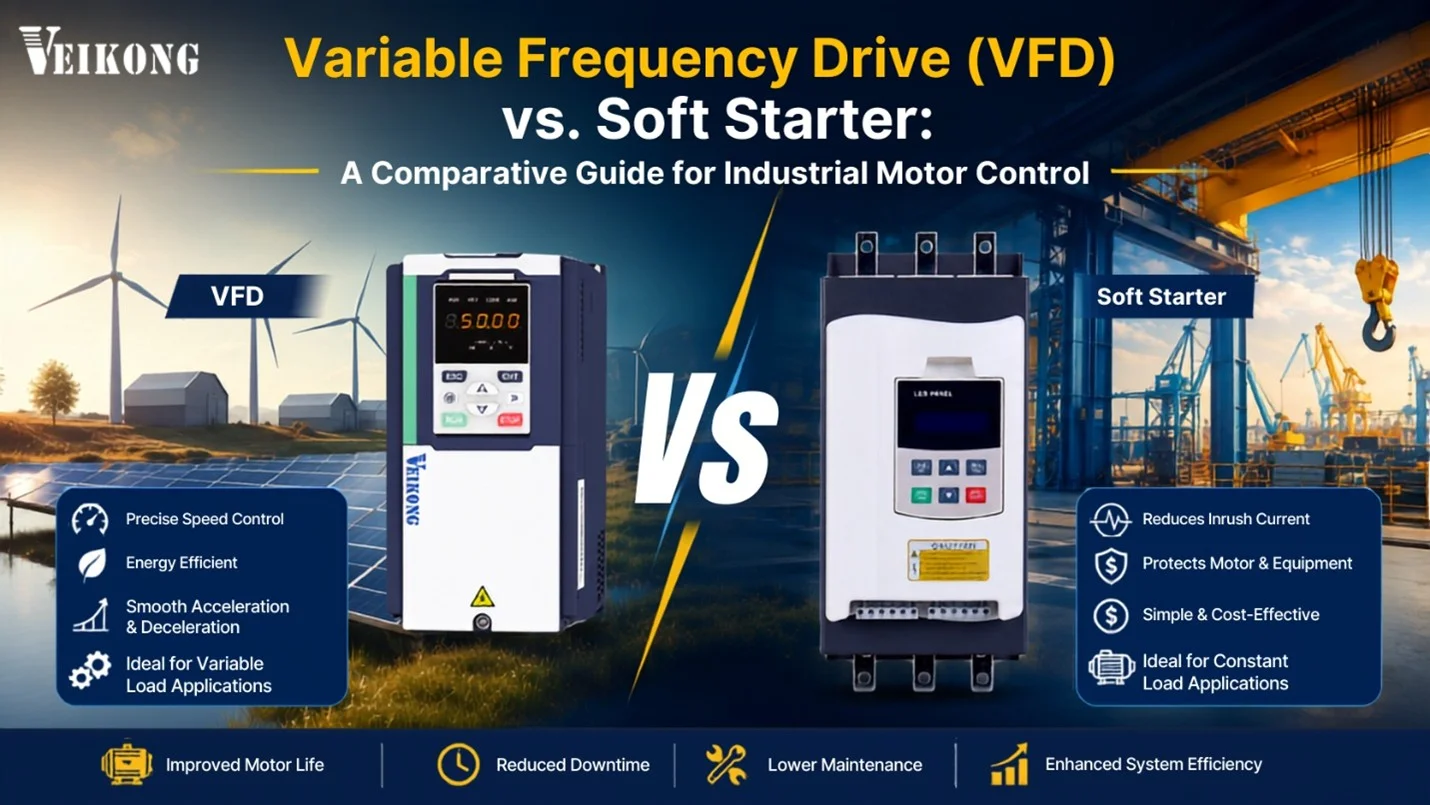
Electric motors run the world’s factories, pumps, fans, and cranes. Starting a motor the wrong way can shorten its life, trip breakers, or waste energy every day. That’s why plant engineers often compare two common solutions: the variable frequency drive (VFD) and the soft starter.
Both devices control how a motor starts, but they do different jobs. Picking the wrong one can mean paying for features you don’t need, or missing you could have had.
This guide breaks down what each device does, where each fits best, and how to choose between them.
What is a Variable Frequency Drive (VFD)?
A VFD is an electronic system used to control an AC induction motor. It manages torque, speed, and motor direction, bringing the motor up to the desired speed at a controlled acceleration rate instead of starting it at full speed instantly.
Utility power runs at a fixed frequency. A VFD breaks that limit, letting one motor run at many different speeds so it can handle a variety of jobs without being oversized or underused.
A VFD system has three parts: an AC motor, usually three-phase; a main drive controller, solid-state electronics that convert power, including a filter, switch, and inverter section; and a control interface, used to start and stop the motor, adjust speed, and change direction.
Modern VFDs are far more compact than older models, mostly because microprocessors have replaced older solid-state components.
When Should You Use a VFD?
A VFD makes sense whenever a process needs more than a simple on/off start:
- To control the speed of a manufacturing process.
- To give the motor a smooth start and a careful ramp-up to operating speed.
- To save energy, especially where a load’s torque and power change over time.
- To improve process quality by managing acceleration, speed, temperature, tension, pressure, and torque together.
- To run a motor in specific patterns that reduce mechanical and electrical stress.
What Is a Soft Starter?
A soft starter solves a narrower problem: the harsh jolt a motor gets when switched on at full voltage. VEIKONG’s S6000 soft starter is an intelligent digital motor soft start system with a complete set of protection functions.
Instead of controlling speed continuously like a VFD, a soft starter ramps voltage up gradually, then runs the motor at full, fixed speed.
According to VEIKONG, this approach cuts system cost, extends equipment life, works as a modern alternative to the traditional star-triangle (wye-delta) starter and the self-coupling decompression starter, and improves system reliability.
Since it doesn’t manage speed after ramp-up, it’s a simpler, more affordable option for motors that only need to run at one speed.
Where Soft Starters Are Typically Used
VEIKONG lists general soft start applications anywhere traditional across-the-line or wye-delta starting would normally apply, including motor fans, compressors, crushers, transmission machines, pumps, and grinders.
For compressors, limiting startup current reduces abrasion and motor heat. For crushers, block protection stops the motor from being damaged during a jam. For pumps, controlled starting reduces water hammer, lowering maintenance costs.
VEIKONG’s soft starters also serve agitators, ball mills, centrifuges, chillers, conveyors, escalators, feeders, hammer mills, lathe machines, flour mills, mixers, pelletizers, plastic and textile machines, presses, rolling mills, saws, vibrating screens, transformers, tumblers, and wood chippers.
VFD vs. Soft Starter: The Core Differences
A soft starter manages the moment of startup. A VFD manages the motor’s entire operating life, from the first second to shutdown.
1. Speed Control
A VFD can hold a motor at any speed within its range, for as long as the process needs. A soft starter only smooths the transition to full speed. Once ramp-up finishes, the motor runs at line frequency, the same as if it started across-the-line.
2. Torque and Starting Behavior
VEIKONG’s hoist and crane drives show what a VFD can do that a soft starter can’t. Their frequency inverters use magnetic flux vector control technology, driven by a high-speed motor control DSP chip, to deliver high starting torque even at low frequency.
That precise, ongoing torque control is what lifting equipment needs for safety. A soft starter isn’t built for this. Its job is a smoother ramp-up, not ongoing torque management.
3. Energy Use in Variable-Load Applications
This is where a VFD offers savings a soft starter can’t match. VEIKONG’s pump application guide explains that when a frequency converter reduces a pump’s speed, the pump curve shifts down and the same flow is achieved at a lower pressure.
Lower pressure means longer seal life, less impeller wear, and less vibration and noise. Because of the affinity laws that govern pump and fan performance, power draw drops sharply as speed drops. That’s the basis for VFD energy savings in these systems.
A soft starter doesn’t touch running speed after startup, so it can’t unlock this kind of ongoing savings. Its value sits at the start of the motor cycle, not throughout it.
Typical Applications
| Situation | Better fit |
| Pump or fan where flow needs to vary | VFD |
| Crane, hoist, or lifting equipment needing precise torque control | VFD |
| Process needing speed adjustments during operation | VFD |
| Compressor, crusher, or conveyor that just needs a gentler start | Soft starter |
| Fixed-speed motor where inrush current is the main concern | Soft starter |
| Budget-sensitive project where full speed control isn’t required | Soft starter |
How to Decide
Does the process need different speeds, or just one? If speed changes during operation, choose a VFD. If the motor only runs at full speed once started, a soft starter may be enough. Is torque control critical, such as in lifting or precision work? Choose a VFD.
Is the main goal simply protecting the motor from the shock of a full-voltage start? A soft starter, like VEIKONG’s S6000, is a direct alternative to star-triangle or self-coupling decompression starters.
Are ongoing energy savings a priority, especially in pump or fan systems with variable loads? A VFD is built for that, since it can shift the pump curve and cut power draw as speed drops.
VEIKONG’s VFD and Soft Starter Lineup
VEIKONG manufactures both device types, making it easier to match the right equipment to the job without switching suppliers.
Variable Frequency Drives Include
- The VFD500 AC Drive (single and three-phase 220V and 380V models)
- The VFD500-PV Solar Pump Inverter
- The VFD 530 AC Drive
- The VFD 500M AC Drive
- The VFD580 AC Drive (VEIKONG’s high-end vector inverter)
- T he VFD550I Electro-Hydraulic Servo Inverter
- The VFD510 IP55 VFD, rated 380V from 2.2kW to 45kW or larger.
Soft Starters Include
- The S6000, an intelligent digital soft start system with complete protection functions
- The VKS-8000 Bypass Soft Starter, which features a built-in bypass contactor
- A PT100 temperature sensor
- Modbus support with optional TCP communication
- The VKS-6000 Online Soft Starter.
Why Motor Control Buyers Work With Veikong
Shenzhen VEIKONG Electric Co., Ltd. has specialized in researching, manufacturing, and trading high-, medium-, and low-voltage frequency inverters since 2004, giving the company more than 20 years of experience in product development and quality management.
VEIKONG’s VFD series uses SPWM, sensorless vector control, and vector and torque control technology, which the company states has reached international advanced standards, letting its products serve as replacements for or equivalents of Europe, U.S., and Japan-made brands. VEIKONG follows the ISO9001 standard for quality management, and its products have passed CE certification.
The company also follows the ISO14001 Environmental Management System and the OHSAS18001 Occupational Health and Safety Management System. Its products serve industries including petroleum, chemical, melting, hoisting, electric power, building materials, water supply, plastics, textiles, printing, and packing.
Summary
A VFD and a soft starter both solve motor-starting problems, but they aren’t interchangeable. A VFD gives continuous speed and torque control, making it the right tool for pumps, fans, cranes, hoists, and any process where speed needs to change or energy savings matter over time.
A soft starter is a more focused, cost-effective way to reduce startup shock on motors that only run at one fixed speed, and it works well as a direct replacement for older star-triangle or self-coupling decompression starters.
VEIKONG manufactures both, backed by more than 20 years of experience, ISO9001 and CE certification, and a product line built to match or replace major international brands. If you’re not sure which device fits your application, their team can help you match the right brand’s drive or starter to your motor and process.