
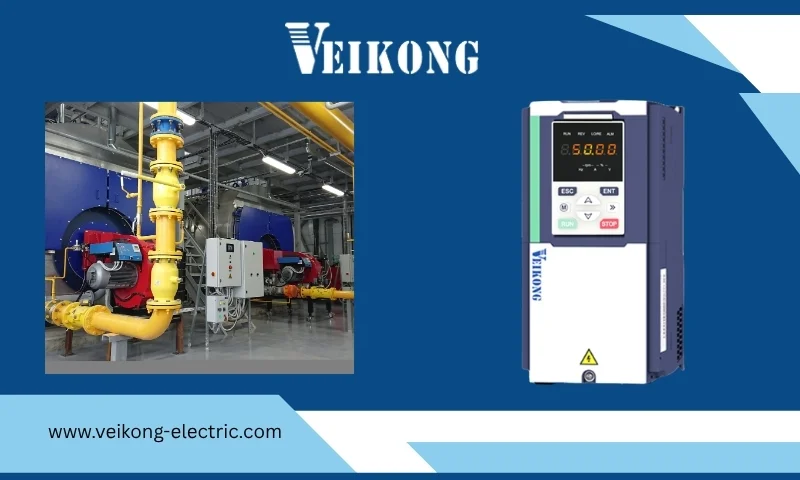
Energy bills are one of the biggest headaches for industrial facilities. Motors run all day, every day, and most of them are pulling full power even when the job does not need it.
That is where AC drives, or Variable Frequency Drives, come in. They are not a new concept, but a lot of facilities are still not using them, and it shows up on the electricity bill every single month.
What is an AC Drive?
A Variable Frequency Drive is an electronic device that controls how an AC induction motor runs. It manages the speed, torque, and direction of the motor.
Instead of the motor going full speed from the moment it starts, the VFD brings it up gradually and keeps it running at only the speed the job actually requires.
Most industrial motors are connected to a fixed power supply. They run at one speed regardless of what the process needs at that moment. A VFD changes that.
It gives operators actual control over the motor, and that control translates directly into energy savings.
3 Basic Parts of a VFD System
- The AC motor is usually a three-phase induction motor.
- The main drive controller, which handles the power conversion using solid-state electronics.
- The control interface, which is where operators manage speed, direction, start, and stop functions.
How AC Drives Save Energy
Here is something worth knowing. Motor power consumption does not drop in a straight line when you reduce speed. It drops much faster than that.
Cut motor speed by 20%, and energy use can fall by close to 50%. That is the cube law at work, and it is why VFDs deliver such strong results on pumps, fans, and compressors.
There is also the startup problem. Every time a motor starts at full voltage, it pulls a large burst of current. That inrush current is hard on the electrical system and hard on the motor itself. A VFD brings the motor up to speed gradually, which removes that spike entirely.
On top of that, many older systems use dampers, valves, or throttles to control flow. Those methods fight against the motor to restrict output. A VFD simply slows the motor down instead, which is a far cleaner and more efficient way to get the same result.
AC Drive Application Across Industries
This is not a technology that works only in specific niche situations. AC drives are used across a wide range of industries and applications:
1. Oil Industry
Boiler fans, ID fans, and FD fans in oil and energy facilities traditionally run at fixed speeds. Putting a VFD on these fans and letting them respond to actual load conditions brings energy consumption down without affecting the process.
2. Air Compressors
A compressor that keeps running at full capacity when demand is low is burning money. VFDs control compressor speed in accordance with the actual pressure level measured in the system to provide output equal to the demand rather than exceeding it.
3. Pumps
Variable frequency drives really prove their efficiency when applied to pumps. This is due to the nature of fluid mechanics, where even a slight decrease in the pump speed leads to considerable energy savings.
4. Hoist and Crane Systems
Hoisting requires controlled torque levels, especially during acceleration and deceleration periods. AC motors provide excellent performance here, as well as cable protection.
5. Injection Molding Machines
Most injection machines use hydraulic systems. Adding variable speed control to the motor driving the hydraulic pump means the system only works as hard as the cycle requires at each stage.
6. Industrial Washing Machines
Different stages of a wash cycle need different speeds. VFDs allow the motor to run at the right speed for each phase automatically, which improves both the wash quality and the energy profile of the whole cycle.
AC Drives and Carbon Emissions
Every unit of electricity saved is one less unit that has to be generated. For most regions, that means less fuel burned at a power station.
When a facility cuts motor energy use by 30 or 40 percent across multiple systems, the carbon reduction is real and measurable.
It is also worth noting that these savings accumulate over time. A VFD installed on a pump or fan that runs continuously does not save energy once. It saves energy every hour the motor runs, for the entire life of the installation.
How to Choose the Right AC Drive
Picking the wrong drive for an application creates problems rather than solving them. Before you begin looking for a VFD, it is useful to know:
- Motor voltage and power rating.
- Operating conditions of the drive, such as temperature, dirt, and humidity.
- If sensorless vector control or complete torque control is necessary in this application.
- Communication requirements, if any, to integrate the drive into an existing system.
This information ensures that the VFD is selected correctly to avoid problems later and achieve the promised energy savings.
Why Shenzhen VEIKONG Electric CO. Ltd. Stands Behind This Technology
Shenzhen VEIKONG Electric Co. Ltd. has been working in the AC drive space since 2004. Over more than 20 years, the company has built experience across research, manufacturing, and supply of variable frequency drives for industrial use worldwide.
The product range covers general-purpose drives like:
- VFD500, VFD530, VFD580: For high-end vector control applications.
- VFD200: As a compact economic option.
- VFD500-PV: Solar pump inverter for solar-powered water systems.
- VKS-8000, VKS-6000: Soft starters for smooth motor startup.
All products use SPWM technology along with sensorless vector control and torque control, built to meet international standards. VEIKONG drives are used in oil, pumping, crane, compressor, molding, and other demanding industries.
Conclusion
Running motors at fixed speeds when the process does not need full output is one of the most common and costly inefficiencies in industrial settings. AC drives straightforwardly solve that problem. They match motor output to actual demand, cut energy waste, reduce wear on equipment, and lower the carbon footprint of the facility at the same time.
The technology is mature, the results are proven, and the range of applications is broad. For any facility looking at ways to reduce energy costs and meet sustainability targets, variable frequency drives are worth serious attention.
To learn more about the full range of AC drives, soft starters, and solar pump inverters, visit veikong-electric.com.