
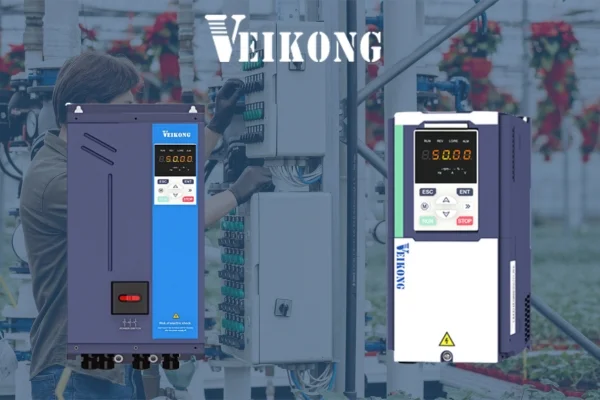
VFD fault codes can stop a production line without any warning. When the drive trips on OC or OV, most operators reset it and get the machine running again.
That works temporarily, but the fault comes right back. The real fix is understanding what caused it in the first place. This guide covers both faults clearly, step by step, in plain language.
What is a VFD and Why Does Faulty Codes Matter?
A Variable Frequency Drive controls the speed and torque of an AC motor by adjusting the frequency and voltage it receives. Instead of running a motor at full speed constantly, a VFD lets you ramp it up gradually and match output to what the process needs.
VFDs are widely used in pumps, air compressors, conveyors, cranes, and injection machines. They protect the motor by detecting faults and shutting down before damage occurs.
Studies show motor and drive-related faults contribute to nearly 30% of unplanned industrial downtime. Knowing how to read and fix these fault codes saves both time and money.
What is an OC (Overcurrent) Fault in a VFD?
An OC fault means the motor is drawing more current than the drive can handle. Most drives trip between 150% and 200% of their rated output current. This does not always mean something is broken. Often, it is just a setting that needs correcting.
Common causes:
- Set the acceleration time too low, causing a current spike on startup.
- Mechanical load is jammed, seized, or overloaded for the drive rating.
- Motor cable insulation damaged or phase-to-phase short circuit.
- VFD settings entered with incorrect motor parameters.
- Bad IGBT output modules inside the drive.
Step-by-step fix:
- Step 1: Open the VFD parameter settings and check the acceleration time. If it is set very short, say 2 to 3 seconds for a large motor, increase to 10 or 15 seconds, and run a test.
- Step 2: Disconnect the motor from its mechanical load and run the VFD with the motor spinning freely. If the fault clears, the drive and motor are fine. The problem is the load. Check for a jammed shaft, or maybe a seized bearing, also possible overloaded conveyor.
- Step 3: Power down and do a quick look at the motor cable. Using a multimeter, measure the resistance between each output terminal pair, U-V, V-W, and U-W. The readings should be pretty close to each other, across all three. If one pair shows a much lower value than the rest, that can suggest a short circuit.
- Step 4: Now compare the motor nameplate values with what you have programmed in the VFD. Rated current, voltage, frequency, and RPM should all match. A mismatch in rated current alone can push the drive into a fault under load.
What Is an OV (Overvoltage) Fault in a VFD?
An OV fault occurs when the DC bus voltage inside the drive exceeds its safe limit. This mostly happens during deceleration, like when the motor slows down, it starts acting a bit like a generator and pushes the energy right back into the drive.
If that energy doesn’t have a place to go, the DC bus voltage just keeps climbing until the drive trips and shuts itself down.
Common causes:
- Deceleration time set too short for your load.
- Input supply voltage running above what the drive is rated for.
- No braking resistor or braking chopper installed.
- A high inertia load that really doesn’t want to slow down, like a big flywheel, or a heavy conveyor belt.
Step-by-step fix:
- Step 1: Increase the deceleration time in the VFD parameters that should help the energy ramp down more calmly. High inertia loads sometimes need a deceleration time two or three times longer than you would initially expect.
- Step 2: Measure the incoming supply voltage at the drive input terminals. For a 380V-rated drive, the supply should stay within the specified input range. If the grid voltage runs high in your facility, that alone can push the drive toward an OV trip.
- Step 3: Check whether a braking resistor and braking chopper are installed. These two components absorb the energy generated during deceleration and release it as heat. Without them, high inertia loads will cause OV faults repeatedly, regardless of other adjustments.
- Step 4: Look for an overvoltage stall function in the VFD parameters. When this is enabled, the drive automatically extends deceleration time when the DC bus voltage climbs too high. Enabling it costs nothing and often resolves the issue without any hardware changes.
One Factor Most Operators Overlook
Both OC and OV faults sometimes come from environmental issues rather than electrical ones. A drive running in a poorly ventilated cabinet or a hot room becomes fault-sensitive.
Check the ambient temperature around the drive and confirm the internal cooling fan is running properly. A blocked or failed fan is a surprisingly common cause behind unexplained fault behavior.
Why Choose Shenzhen VEIKONG Electric Co. Ltd. For Your VFD Needs?
When selecting a VFD, the manufacturer matters as much as the product itself. Shenzhen VEIKONG Electric Co. Ltd. is a professional AC drive enterprise based in Shenzhen, China.
Founded in 2004, the company has over 20 years of focused experience in researching, manufacturing, and trading high, medium, and low voltage frequency inverters.
This is not a general electronics company that also makes drives. Drives are their core business.
What Sets Them Apart
- 20-plus years of experience exclusively in the VFD and AC drive space.
- Technology built on SPWM, sensorless vector control, and torque control, meeting international advanced standards.
- Products that can directly replace or serve as equivalents to European, American, and Japanese drive brands.
- Solutions covering general-purpose drives, high-end vector drives, solar pump inverters, soft starters, and specialized VFDs.
- Industry applications in oil and gas, pumps, air compressors, hoists and cranes, injection machines, and washing machine systems.
Product Lineup
- VFD500 and VFD530 AC Drives for general-purpose motor control.
- VFD580 AC Drive for high-end vector control applications.
- VFD500M AC Drive for economical variable speed use.
- VFD500-PV Solar Pump Inverter for solar-powered water pumping.
- VKS-6000 and VKS-8000 Soft Starters for controlled motor startup.
- S6 Servo Drive for precision motion control.
Every product includes built-in overcurrent and overvoltage protection, which reduces fault trips and unplanned downtime across industrial operations.
Their Global Reach
VEIKONG serves clients across more than 200 global markets, has worked with over 150 satisfied clients, and has earned 150-plus industry awards. Their technical support team is available through:
Final Thoughts
OC and OV faults are fixable in most cases without replacing the drive. Work through the steps above in order, check the settings first, then the wiring, then the mechanical side. You will find the cause faster than expected.
And if you need a drive built to handle demanding industrial conditions with fewer fault interruptions, Shenzhen VEIKONG Electric Co. Ltd. has the experience and the product range to back it up.