
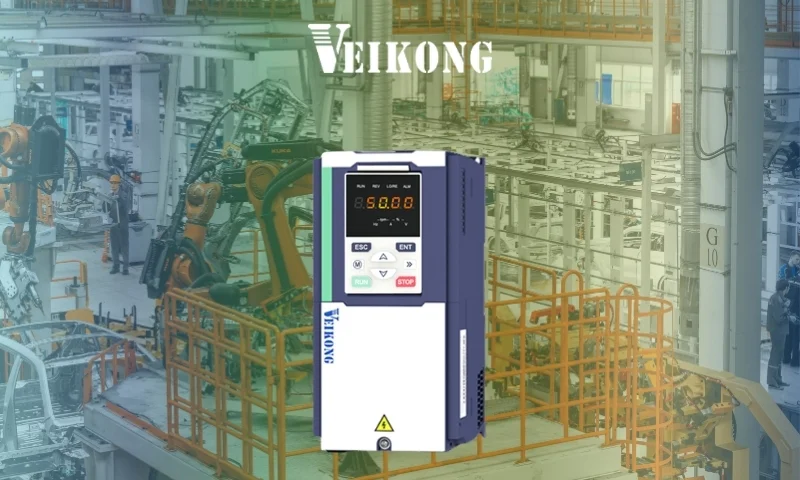
The modern industrial world places greater importance on efficiency, accuracy, and longevity of equipment than ever before. Whether you are operating pumps, fans, conveyors, compressors, or specialized machinery, selecting the right Variable Frequency Drive (VFD) for your motor can significantly improve performance while reducing energy consumption and maintenance costs.
At VEIKONG Electric, we know that selecting the best VFD cannot be as simple as matching voltage and power ratings. It concerns identifying a dependable drive solution that meets your motor attributes, application, and requirements based on control and long-term operating objectives.
We have decades of experience in the research, production, and distribution of high technology AC drives and frequency inverters, which have assisted industries the world over to make optimal use of their motor control systems. This guide will take you through the key considerations in selecting the appropriate VFD to fit your motor.
- Understand Your Motor Specifications First
The first step is to compile the essential technical information of the motor before choosing the VFD. The specifications are normally located on the motor nameplate and are important for drive matching.
Important motor data includes:
- Rated voltage
- Full load current (FLC)
- Horsepower (HP) or kilowatts (kW)
- Frequency (Hz)
- Rated speed (RPM)
- Number of phases
- Motor type (induction, PMSM, etc.)
These electrical parameters should be compatible with the VFD to assure safe and efficient operation.
- Identify the Type of Load Application
The type of load is one of the most significant factors in selecting a VFD since various applications have varying torque characteristics and requirements.
Variable torque applications
Examples include:
- Fans
- Centrifugal pumps
- Blowers
These loads generally have lower torque requirements at lower speeds and are therefore suited to energy-saving VFD control.
Constant torque applications
Examples include:
- Conveyors
- Mixers
- Extruders
- Positive displacement pumps
These applications need steady torque across the speed range.
Constant horsepower applications
Examples include:
- Machine tools
- Winders
- Spindles
Such systems require constant power at varying rates.
The selection of an incorrect type of drive to drive the load will lead to either poor performance, overheating, or unnecessary loss of energy.
- Match the VFD Power Rating Correctly
One of the misconceptions is to choose a VFD depending solely on the horsepower of the motor. Horsepower is important, but, currently, rating may be more critical.
Why? Due to heavy-duty loads on motors, the current may be exceeded.
VEIKONG recommendation:
Always compare:
- Motor full load current
- Overload requirements
- Application duty cycle
Then select a VFD that has enough current-carrying capacity.
In harsh industrial applications, a small oversizing of the VFD may be used to offer extra reliability and thermal protection.
- Consider Input Power Supply
Your facility’s available power supply directly affects VFD selection.
Key questions to ask:
- Is the input power single-phase or three-phase?
- What is the available voltage?
- 220V?
- 380V?
- 480V?
- Is the power quality stable?
VEIKONG Electric has single-phase and three-phase VFDs available to accommodate various industrial systems and installation environments.
- Evaluate Speed Control Requirements
Not every application requires the same level of speed and precision.
Basic applications may only need:
- Start/stop control
- Simple acceleration
- Deceleration adjustment
Advanced systems may require:
- Precise speed regulation
- Torque control
- Position control
- Closed-loop feedback
- Vector control
In high-performance motor applications, the high-speed torque, constant operation, and responsive motor behavior of VEIKONG are offered through the advanced use of vector control technology.
- Check Environmental Conditions
The installation environment greatly impacts VFD reliability.
Consider factors such as:
- Ambient temperature
- Dust exposure
- Moisture or humidity
- Ventilation
- Altitude
- Corrosive environments
When the VFD is to be used in severe industrial conditions, extra enclosure protection or cooling provisions might be required.
High-quality thermal management and robust drive construction contribute to the system’s life.
- Look for Built-In Protection Features
Modern VFDs do much more than control speed.
They also protect both the motor and connected equipment.
Important safety protections include:
- Overcurrent protection
- Overvoltage protection
- Undervoltage protection
- Overtemperature protection
- Short circuit protection
- Overload alarms
At VEIKONG Electric, reliability and equipment safety remain core priorities in our drive designs.
- Communication and Automation Compatibility
In smart factories and automated systems, communication capability matters.
Consider whether your VFD needs integration with:
- PLC systems
- HMI interfaces
- SCADA systems
- Modbus communication
- RS485 networking
Selecting a drive with the right communication protocols ensures smoother automation and better process monitoring.
- Energy Efficiency Matters
One of the biggest benefits of using a VFD is energy savings.
By adjusting motor speed according to actual load demand instead of running continuously at full speed, businesses can significantly lower power consumption.
VEIKONG highlights that reducing motor speed in non-peak demand conditions can dramatically improve efficiency while extending component life.
For pumps and fans especially, VFD-based speed control often delivers substantial operational cost savings.
- Choose a Trusted VFD Manufacturer
Even the best specifications mean little without product quality, technical support, and long-term reliability.
When selecting a VFD supplier, consider:
- Manufacturing experience
- Quality certifications
- Technical support
- Product consistency
- Customization capability
- Global service reach
At VEIKONG Electric, quality is the life of our enterprise. With advanced R&D, strict quality management standards, and years of industry expertise, we deliver dependable VFD solutions trusted across diverse industrial sectors.
Final Thoughts
The selection of a Variable Frequency Drive suitable for your motor is a strategic move that influences the energy consumption, reliability of your system, quality of your production, and the maximum start and stop life of your equipment.
The best VFD selection comes from understanding:
- Your motor specifications
- Load requirements
- Control precision
- Power supply conditions
- Environmental challenges
- Automation needs
At VEIKONG Electric, we are determined to assist businesses in getting intelligent motor control solutions that enhance performance in their operations and lower the total cost.
Whether you need a VFD for pumps, conveyors, compressors, fans, or custom industrial systems, our professional team is ready to support your application with reliable, high-performance drive technology.
Need Help Selecting the Right VFD?
Contact VEIKONG Electric today to discuss your motor application requirements. Our experts can help you choose the most suitable Variable Frequency Drive solution for maximum efficiency, protection, and performance.
Explore our VFD solutions: VEIKONG Electric VFD Solutions.