
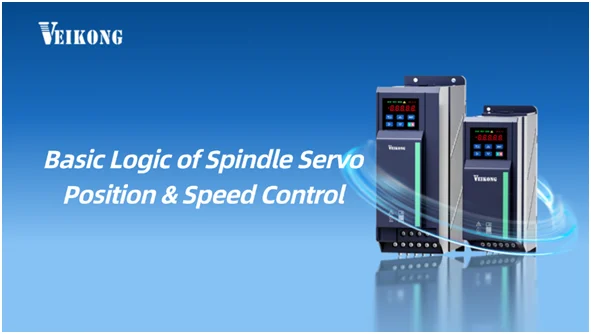
In modern CNC machining industry, the spindle system is the heart of machine tool processing, directly determining workpiece surface finish, dimensional accuracy and production efficiency. Among all core components, spindle servo drive undertakes speed regulation and precise positioning tasks, where speed control and position control are the two most fundamental underlying control logics. Understanding these two working principles helps machinery manufacturers and end users correctly recognize, select and apply CNC spindle drive systems.
Speed control is the basic running mode of any spindle system. Essentially, it relies on advanced vector control algorithms to adjust output frequency and torque, enabling the spindle motor to maintain stable stepless rotation across low, medium and high speed ranges. Unlike ordinary general-purpose inverters, professional spindle servo adopts optimized control strategies to achieve smooth acceleration and deceleration without obvious jitter during start-up, shutdown and speed switching. This stable speed output effectively avoids tool marks and vibration patterns on workpieces, laying a solid foundation for high-quality finishing and conventional roughing processes.
Beyond basic speed regulation, modern CNC production puts forward higher requirements such as spindle orientation, fixed-angle indexing and automatic tool change, which makes position control an indispensable core function of high-end spindle servo. Position control collects real-time angle and displacement signals through encoders, forms closed-loop feedback with the drive, and dynamically corrects operating deviations. This control method can make up for mechanical transmission clearance and structural deformation errors, realizing accurate fixed-point stop and angle locking, and greatly improving the automation level and batch processing consistency of CNC machine tools.
According to different feedback modes, spindle position control is mainly divided into semi-closed loop and full closed loop. Semi-closed loop control realizes position feedback through the motor end encoder, meeting conventional cutting demands. Full closed loop adds independent spindle encoder feedback to further optimize positioning accuracy, which is widely used in high-standard scenarios such as machining centers, CNC boring and milling machines. Compatible with multiple encoder protocols and flexible frequency division output, mainstream spindle servo drives can match various types of spindle motors and CNC system platforms.
As a professional brand focusing on industrial drive and spindle servo technology, VEIKONG has accumulated more than 20 years of R&D and management experience in the field of AC drives, always focusing on solving actual spindle control pain points for CNC equipment.
Representing VEIKONG’s mature spindle control technology, S6 Series Spindle-specific Servo Drive perfectly integrates optimized speed control and position control functions. It supports wide frequency range, semi-closed and full closed-loop positioning, powerful motor self-learning, multiple CNC bus and pulse interfaces, as well as strong overload and weak magnetic speed-up performance. With compact structure, independent air duct design and high anti-interference capability, S6 covers full power range of 2.2kW–11kW at 220V/380V, perfectly adapting to asynchronous and permanent magnet synchronous motors and all kinds of mainstream CNC lathes, milling machines, grinding machines and gantry machine tools.
To sum up, speed control ensures the stable operation and processing efficiency of the spindle, while position control guarantees machining precision and intelligent production. Mastering these two core logics is the key to selecting excellent spindle drive products. With reliable algorithm strength and complete product performance, VEIKONG S6 becomes an ideal high-performance spindle servo solution for modern CNC machining.