
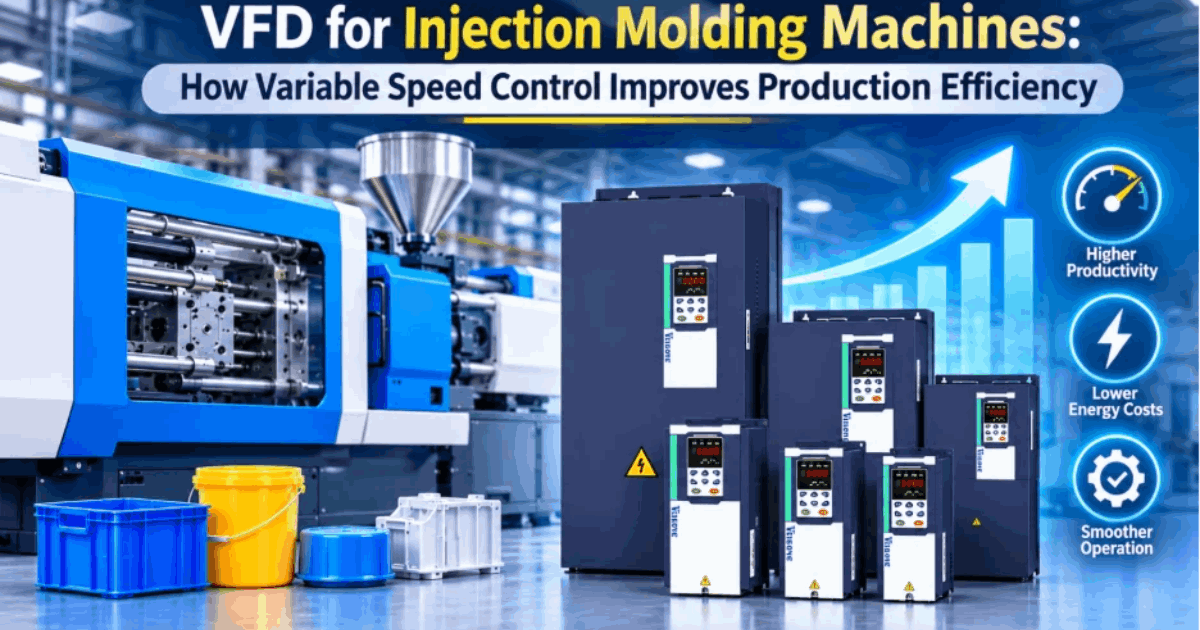
Plastic parts come off injection molding machines by the thousands, and every one of them starts with a motor turning an oil pump. Most injection molding machines on the market are hydraulically driven. The oil pump supplies the power, and the motor behind it decides how much that power costs to produce.
The problem is that the machine never needs the same amount twice in a row. A single cycle moves through several steps, and each step wants a different flow and pressure. A motor running at one fixed speed cannot follow those changes. A variable frequency drive (VFD) can.
This post explains where energy is lost in a hydraulic injection molding machine and how variable speed control addresses it.
How a Hydraulic Injection Molding Machine Works
The machine follows a set order of steps in every cycle:
- Mold locking
- Holding pressure after injection
- Melting the plastic and feeding it forward
- Cooling
- Mold opening and ejection
Each step depends on careful coordination of time, pressure, speed, and position. Every movement has its own matching pressure and speed, and those values change with position and time. When one step finishes, a signal goes to the program controller. The controller then sends the order for the next step.
The load swings a lot from one stage to the next. That is the starting point for the energy problem.
Where a Traditional Machine Wastes Energy
A traditional machine uses a constant pump to supply oil. The motor holds one speed for the whole cycle, so the oil supply stays fixed. Yet the work is intermittent, so the machine is rarely fully loaded.
The extra energy has to go somewhere. It ends up in the damper, in leakage from the oil circuit, and in heating the oil. That creates further problems:
- More wear among the valves
- An oil circuit that runs too hot
- A machine that is noisier than it should be
Measurements show that at least 50% of the energy is wasted in a fixed oil-supply system.
What Does a VFD Do on an Injection Molding Machine?
A VFD is an electronic system that controls an AC induction motor. It can control torque, speed, and motor direction, and it starts the motor smoothly at a controlled acceleration rate.
On an injection molding machine, the drive does three main things:
- It reads the proportional pressure and flow signals from the injection molding control system.
- It adjusts the motor speed for each step of the cycle. This is called flow regulation.
- It stops the motor when the machine is not working, mainly during cooling.
The result is that pump flow and pressure match what the system needs at that moment, and nothing more.
How Variable Speed Control Improves Production Efficiency
Efficiency in molding is about more than the power bill. A VFD brings several benefits to injection machine applications:
- Energy savings: Power savings of 30% to 70% are possible.
- Soft start: A gentle start prolongs the life of the equipment and the mold.
- Lower noise: A quieter machine improves the working environment.
- Easy operation: The drive is simple to use.
- High reliability: The drive is built to run dependably in production.
Less wasted oil heat also means less strain on the valves and the oil circuit, which are the parts that suffer when energy is wasted.
How Much Energy Can a VFD Save?
On injection machines, power savings can reach 30% to 70%. For the VFD550I drive described below, the comprehensive power saving rate is 20% to 60%. Actual results depend on the machine and how it is used.
Veikong’s VFD550I for Hydraulic Applications
Shenzhen Veikong Electric Co. Ltd. is an AC drive company that researches, manufactures, and trades high-, medium-, and low-voltage frequency inverters. It has operated since 2004. For injection molding, Veikong offers the VFD550I Electro-Hydraulic Servo Inverter.
The VFD550I is designed for hydraulic control. It has a built-in pressure control algorithm that is fast, accurate, and stable. It can be used for energy-saving transformation of injection molding machines, die-casting machines, hydraulic stations, and electric melt adhesives.
Key specifications:
- Voltage: 380V to 480V
- Power range: 0.7kW to 710kW
- Motors supported: Asynchronous motors (IM) and permanent magnet synchronous motors (PMSM)
- Control modes: VF, SVC and VC
- Communication: 485 as standard, with PN and CAN optional
- Protection level: IP20
- Brake unit: Standard up to 90kW, external from 110kW
- DC reactor: Optional from 18.5kW to 200kW, standard from 220kW
The drive also includes AI zero-drift automatic correction and supports common incremental encoders and rotary transformers. It handles both closed-loop and open-loop vector control.
How Precise Is the Pressure Control?
The closed-loop pressure algorithm lets the speed and pressure of the injection molding system follow commands quickly and steadily. The figures are:
- Pressure control overshoot of ≤±1%
- Steady-state fluctuation of ≤±0.5 Bar
Steady pressure matters because every step in the cycle depends on it.
FAQs (Frequently Asked Questions)
1. Which Veikong drive is made for injection molding machines?
The VFD550I Electro-Hydraulic Servo Inverter is made for injection molding machines.
2. Can it run on different motor types?
Yes, it supports asynchronous motors and permanent magnet synchronous motors.
3. What voltage does it use?
It uses a voltage of 380 V to 480V.
4. Does it help when the machine is idle?
Yes, stopping the motor while the machine is off-duty, mainly during cooling, saves more energy.
5. Are manuals available?
Yes, a catalogue and a user manual are available for the VFD550I.
Summary
Hydraulic injection molding machines need different flow and pressure at each step, but a fixed-speed motor cannot follow. In a traditional system, at least 50% of the energy is wasted, and the waste shows up as oil heat, valve wear, and noise.
A VFD changes the picture by adjusting motor speed at each step and stopping the motor when it is idle. Power savings of 30% to 70% are possible on injection machines, along with soft starts, lower noise, and easier operation. The VFD550I adds a dedicated pressure control algorithm, support for two motor types, and a range from 0.7kW to 710kW.
If you are planning an energy-saving upgrade for an injection molding machine, the Veikong team can help you choose the right drive. Reach out to them to talk through your application.