
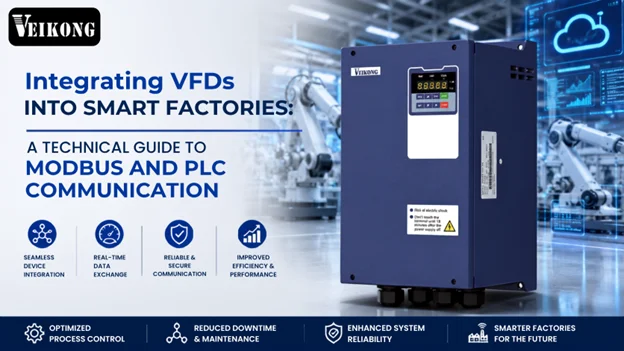
Modern factories increasingly rely on equipment that can share data in real time. A pump reports back to the system managing the boiler. A crane’s motor sends load data to a control room on the other side of the plant.
This level of coordination is not accidental. It depends on two pieces of equipment that can exchange information in a common format. The first is the variable frequency drive, or VFD.
The second is the programmable logic controller, or PLC. When these two systems communicate reliably, a factory moves from operating as a set of independent machines to functioning as one coordinated system.
This guide explains how that connection works, which protocol makes it possible, and what to look for in a drive designed for this kind of integration.
What a VFD Actually Does
A variable frequency drive is an electronic system that controls an AC induction motor. It manages torque, speed, and direction, and it starts a motor smoothly instead of slamming it up to full speed. Instead of running a motor at one fixed speed off the power grid, a VFD lets you dial in exactly the speed a process needs, then change it on the fly.
A VFD system generally has three parts:
- An AC motor: Usually a three-phase induction motor.
- A main drive controller: Solid-state electronics that convert and switch power through a DC-link, filter, and inverter section.
- A monitoring and control interface: The part that starts, stops, and adjusts the motor.
Modern drives have shrunk a lot over the years, mostly because microprocessors replaced older solid-state parts. That shrinkage matters for smart factories, because a smaller, smarter drive has more room left over for communication hardware.
Why Modbus Matters for VFD-PLC Communication
A smart factory needs its machines to report data and accept commands without a person standing at every panel. Modbus is one of the oldest and most widely used protocols for this job. It’s simple, it’s open, and most industrial equipment supports it in some form. That’s exactly why it shows up so often when a VFD needs to talk to a PLC.
In practice, Modbus lets a PLC read a drive’s status, like speed, fault codes, or temperature, and write new commands back, like a new target frequency or a start/stop signal. The PLC acts as the master, polling each drive on the network in turn.
This keeps wiring simple, since one communication cable can often replace a tangle of separate control wires running to every drive on the floor.
Communication Protocols Built Into Veikong Drives
Not every VFD is built with this kind of networking in mind. Veikong designs its higher-end AC drives specifically to plug into automated, PLC-driven environments.
1. VFD580: High-End Drive with Multi-Protocol Support
The VFD580 is Veikong’s high-standard vector inverter, built for applications that demand strong overall performance, including electromagnetic compatibility and scalability. On the communication side, it supports:
- Modbus
- CANopen
- Profinet
- EtherCAT (on the VFD586 variant)
The drive also comes with a standard LCD that shows a real-time clock, supports multiple languages, and allows parameter upload and download, along with software upgrades.
It supports PC tool software for setup and diagnostics, so an engineer can configure the drive from a laptop instead of a keypad. For applications like pumps and fans, it includes an energy-saving function for light loads, and it supports SVC vector control and closed-loop vector control for high-precision work.
2. VFD530: Communication Built for Lifting and Precision Work
The VFD530 is Veikong’s high-performance PMSM AC drive, built on the VFD500 platform, meaning it inherits all of that series’ functions and adds more. Its communication feature set includes:
- Modbus
- CANopen
- Profinet
- TCP communication
It also supports multiple PG cards and protocols, which matters for applications using encoder feedback. The drive runs on a 256K TI CPU, giving it faster response and higher precision, and it supports closed-loop PG card operation for both synchronous and asynchronous motors.
For lifting applications like hoists and cranes, it includes a special brake logic function and standard double relay output.
Built-In PLC Functionality: One Less Box to Wire
Here’s something that often gets missed when people plan a smart factory retrofit: some VFDs don’t just talk to a PLC; they can act like a small one.
Both the VFD580 and VFD530 include a built-in comparator and logic control unit that functions as a simple PLC. This means basic interlocks, threshold checks, and logic sequences can run directly inside the drive, without needing a separate controller for every small task.
For a factory floor with dozens of drives, this can cut down on the number of external PLCs needed just to handle simple logic, while the plant-wide PLC still handles the bigger picture through Modbus or another supported protocol.
The VFD530 adds double PID function support on top of this, useful for processes that need two independent control loops running at once, such as pressure and flow control on the same line.
Soft Starters Join the Network Too
VFDs aren’t the only piece of motor control equipment that needs to report into a PLC-based system. Veikong’s VKS8000 series bypass soft starter also supports Modbus communication, with optional TCP communication available.
It includes a built-in bypass contactor and a PT100 temperature sensor, so a PLC can monitor motor temperature alongside start and stop status through the same network used for the drives.
This matters in mixed environments, which are common. A factory rarely runs on VFDs alone. Large motors that only need a controlled start, rather than variable speed, are often paired with a soft starter instead. Having both device types speak the same protocol keeps the PLC program simpler and the wiring more consistent across the plant.
Where This Shows Up on the Factory Floor
Veikong’s drives are used across a range of industrial settings where speed control and network integration both matter:
- Oil industry equipment: Including energy-saving work on ID and FD fans for industrial boilers.
- Air Compressors: Where a remote pressure sensor feeds data back for gas supply control.
- Hoist and crane systems: Which need strong torque control for lifting.
- Pumps: Where the affinity laws for pumps and fans make frequency control especially useful for energy savings.
- Injection molding machines: Many of which traditionally rely on hydraulic drives.
- Disk-type plastic molding machines: Which see sharp internal load changes during operation.
In every one of these cases, the drive isn’t working alone. It’s reporting status and taking commands from a larger control system, which is exactly the role Modbus and PLC integration are built to support.
Quality Standards Behind the Hardware
Communication protocols only matter if the hardware behind them is reliable. Veikong follows the ISO9001 standard to manage and supervise product quality, and its products carry CE certification along with other technical approvals.
The company also states that its Environment and Occupational Health and Safety Policy complies with the ISO14001 Environmental Management System and the OHSAS18001 Occupational Health and Safety Management System.
Veikong has more than 20 years of experience in variable frequency drive research, manufacturing, and trading, dating back to 2004.
The company states its VFD products use SPWM, sensorless vector control, and vector and torque control technology, and describes this as reaching an internationally advanced standard, positioned to directly replace or match equivalent products from Europe, the United States, and Japan.
Summary
Connecting a VFD to a PLC isn’t just a wiring exercise. It’s what turns a standalone motor drive into part of a coordinated, data-driven factory.
Modbus remains one of the most common ways to make that connection, and Veikong builds it into its VFD580 and VFD530 drives alongside other protocols like CANopen, PROFINET, EtherCAT, and TCP communication.
Add in built-in PLC-style logic control and Modbus-ready soft starters, and a plant can standardize its communication layer across most of its motor control equipment.
If you’re planning a smart factory upgrade and want to know which Veikong drive fits your existing PLC network, reach out directly:
- General inquiries: info@veikong-electric.com
- Technical support: Service@veikong-electric.com
- Phone: +86-0755-89587650
- WhatsApp: +86 15989436541
- Address: 4F, Building 5, Dongluyang Industrial Park, No. 4, Tengfeng 4th Road, Fuyong Phoenix Third Industrial Zone, Baoan District, Shenzhen, China