
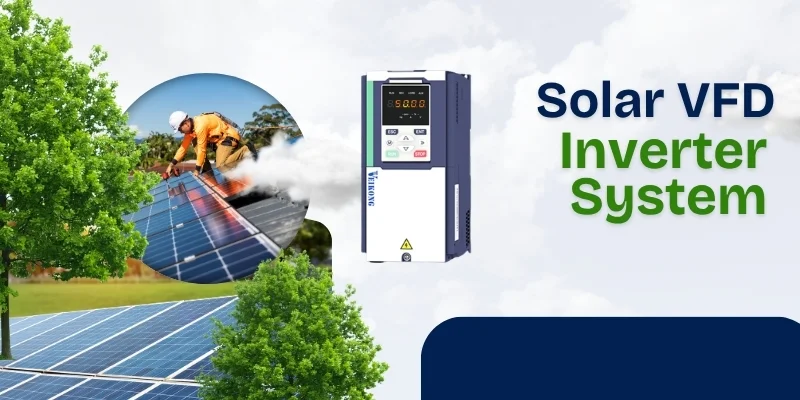
Farmers in Africa and Asia are done with diesel pumps. Fuel costs too much, breaks down too often, and is hard to find in remote villages.
Solar VFD inverter systems are a practical replacement. They run on sunlight, need little replacement, and keep water flowing without a monthly fuel bill.
This is why farmers are switching from diesel pumps with solar VFD inverter systems in 2026.
What Is a Solar VFD Inverter?
Solar VFD inverter is a device that takes DC electricity from solar panels and converts it into AC electricity to run a water pump.
The VFD part controls how fast the pump runs based on how much sunlight is available. More sun, faster pump. Less sun, slower pump. The system adjusts on its own.
No batteries needed. No manual adjustments. As long as there is daylight, the pump works.
Why Diesel Pumps Are Losing Ground
Diesel pumps were never a perfect solution. They were just the most available ones. That is changing now.
Here is what farmers deal with every season when running a diesel pump:
- Fuel in remote areas costs 20 to 40 percent more than city prices because of transport.
- Engines need servicing every few months and spare parts are often hard to source locally.
- Breakdowns happen mid-season, when there is no time to wait for repairs.
- Someone has to be physically present to operate and refuel the machine.
- In many parts of Africa and Asia, up to a third of farm operating costs go to diesel fuel alone.
That last point is what is pushing farmers toward solar. When one third of your income goes to fuel, free sunlight starts making a lot of sense.
General industry data shows farmers who switch from diesel to solar irrigation can cut their pumping costs by up to 80 percent over time. That is real money staying in the farmer’s hands.
How the System Works on a Farm
Solar panels go up in an open area to catch maximum sunlight. They connect to the solar VFD inverter. The inverter connects to the water pump. The pump draws water from a borehole, well, river, or canal. That is the whole setup.
From there, the system runs itself. The common question farmers ask is what happens when it is cloudy or after sunset.
Modern solar pump inverters handle this by accepting both solar DC power and standard AC grid power. When sunlight drops, the system switches to grid power automatically. Water supply continues without interruption, day or night.
VEIKONG Electric: Powering Solar Irrigation Across Africa and Asia
Shenzhen VEIKONG Electric Co., Ltd. is a high-tech company based in China, developing and manufacturing solar pump inverters since 2018. They also make a full line of variable frequency drives for industrial applications.
The company has an R&D team with more than 20 years of combined experience. Our products are international standard products and are designed to compete with the leading brands of Europe, USA and Japan.
Their inverter range is from 1 KW to 710 KW and they serve from small family farms to large commercial irrigation projects.
Visit https://veikong-electric.com to know more.
The VFD500-PV: VEIKONG’s Solar Pump Inverter
The VFD500-PV is VEIKONG’s main solar pump inverter, built specifically for water pumping systems. Here is what it offers:
1.Up to 99% MPPT efficiency
Nearly all available solar energy gets converted into usable power. On cloudy days when sunlight is limited, this level of efficiency keeps the pump running when a lower-quality inverter would stop.
- Automatic startup
Connect the panels, turn them on, and the pump starts. No tricky settings, no technician required. This is important in rural areas where technical help is not available.
- Suitable for surface and submersible pumps
The technique is used for water near the surface or much below the surface.
- Remote Monitoring via GPRS
Pump status and water flow, daily production and power generation may be viewed from any computer or phone, anywhere. Good for farmers and project managers with many sites.
- In-built protection
The inverter is protected against dry running, overheating, overvoltage, short circuit, missing phases and low frequency. These precautions increase the pump and inverter life.
- Frequency transformation technology
The inverter adjusts its AC output based on real time sunlight. So a 4 KW pump may operate with only 1 KW of solar input. It will run slower but will still provide water instead of halting altogether.
What the Data Says About Solar VFD Adoption in 2026
The shift to solar irrigation is not happening slowly.
- Solar panel prices have decreased by around 90% since 2010, making the initial investment much more affordable.
- Solar water pump installations in Africa have increased by more than 20 percent annually in recent years.
- There are more than 570 million farms in the world, most of them in Asia and Africa, and many without a reliable grid.
- Farmers switching from diesel to solar report fuel and maintenance savings of up to 80 percent.
Falling hardware costs combined with rising diesel prices have tipped the balance. The payback period on a solar irrigation system is getting shorter every year.
VEIKONG’s Reach in Africa and Asia
VEIKONG has been growing its presence in the markets where solar irrigation is most needed. In July 2025, we participated in Asian Sustainable Energy Week, where the company marketed the VFD500-PV to buyers and project developers throughout Asia.
The product has been well received in Thailand, Turkey, and several African countries. In Turkey, customers reported that the system performed well in cloudy and variable weather, with special mention of its MPPT efficiency and reliability.
VEIKONG has focused the VFD500-PV on community water supply, agricultural irrigation, and off-grid water access projects in Africa. The automatic grid-switching feature addresses a core concern in many African markets, keeping water available even when sunlight is not.
Is the Switch Worth It for Small Farmers?
For most farmers, yes, this switch is worth it. The upfront cost is higher than that of a diesel pump. But once installed, running costs drop close to zero. No fuel, minimal maintenance, and the system lasts 20 or more years alongside the solar panels.
A farmer currently spending around $150 to $250 a month on diesel could recover the cost of a basic solar setup within one to three years. After that, the water supply costs almost nothing.
For development programs, NGOs, and government irrigation schemes, solar VFD systems represent one of the most practical infrastructure investments available right now.
To explore VEIKONG’s full solar pump inverter range, visit https://veikong-electric.com