
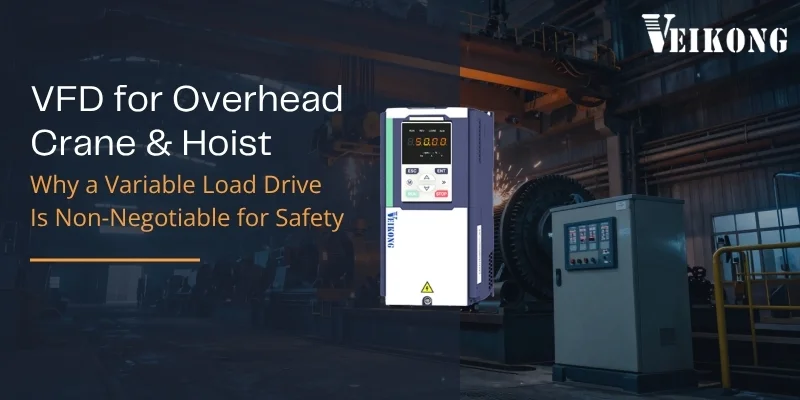
Overhead cranes are among the most heavily used pieces of equipment on any industrial floor. They lift steel coils, shift heavy machinery, and move loads that no forklift could safely handle, often for hours at a stretch.
Yet one critical component rarely gets the attention it deserves: the motor controller that governs how the crane lifts, holds, and lowers each load.
That component is the variable frequency drive, or VFD. In most industrial applications, a VFD is valued mainly for energy savings. In crane and hoist operations, its role is far more significant. It determines whether a load rises smoothly and predictably or unevenly and unsafely.
Safety reviews of overhead crane incidents consistently point to the same recurring causes: sudden load drops, abrupt starts, and braking systems that respond too slowly. A closer look at these cases reveals a common thread: the motor control system was never designed to meet the specific demands of lifting equipment.
What a VFD Does on a Crane
A VFD regulates the speed, torque, and direction of an electric motor with precision. Rather than allowing a motor to run at full output the instant power is applied, the VFD manages acceleration and deceleration in a controlled manner.
Speed transitions occur gradually, direction changes are clean, and torque output remains stable even at very low motor speeds. This level of control is especially critical in crane operations. A load lifted too quickly can swing or sway unpredictably.
A motor that loses torque at low speed may allow a heavy object to sag or shift before the mechanical brake fully engages. The VFD is responsible for preventing these outcomes, maintaining stable, controlled motion from the moment the hook begins lifting until the load is set down.
The Safety Risks of Inadequate Crane Motor Control
The numbers around crane safety are sobering once you actually look at them. Reviews of hundreds of overhead crane incidents have tied them to well over 800 separate safety violations, with injuries and fatalities running close to even.
A large share of these injuries comes down to one thing: someone being struck by a load that moved when it shouldn’t have. Bureau of Labor Statistics figures on crane fatalities tell a similar story.
A meaningful portion of these deaths happens not on construction sites, but inside factories and plants, the exact setting where overhead cranes and hoists are used every single day. Struck-by incidents, falling objects, and uncontrolled load movement show up over and over in these reports.
None of this happens by accident, no pun intended. It happens when motor control isn’t strong enough for the job. A drive with weak low-speed torque, mismatched braking, or no synchronization between dual lifting points is setting the stage for exactly this kind of failure.
What a Crane-Grade VFD Should Offer
General-purpose drives are not built for hoisting. A drive meant for lifting work needs to handle a different set of problems, and a few features separate a real crane drive from a basic one:
- High starting torque, even at very low frequency, so the motor doesn’t lose grip on a load right when lifting begins.
- DC excitation control, which speeds up the motor’s torque response so there’s no lag between command and output.
- Electrical braking that works hand in hand with the crane’s mechanical brake, so one system backs up the other instead of leaving a gap.
- Fast, controlled stopping during emergencies, without damaging the motor or letting the load drop.
- Speed synchronization between motors on dual-point lifts, since even a small mismatch can tilt a load dangerously.
- Torque balancing across two large motors sharing one hoisting mechanism through a gearbox.
- Automatic motor parameter tuning, so performance stays accurate without hours of manual calibration.
- Support for industrial communication protocols such as PROFIBUS-DP and MODBUS so the drive can talk to PLCs and other equipment on the line.
These aren’t extras. Each one addresses a specific failure mode that shows up repeatedly in crane accident data.
Common Applications for Crane and Hoist Drives
It’s not just straight up-and-down lifting. Crane and hoist VFDs handle several types of movement on a typical job:
- Vertical lifting and lowering
- Pitching and luffing on jib or tower cranes
- Trolley and wheelbarrow travel
- Gyration, meaning rotational movement
- Grabbing operations, where the load weight can change in an instant
Each of these puts a slightly different strain on the motor, which is why a proper crane drive comes with multiple control modes rather than one fixed setting.
Why VEIKONG Electric Is a Trusted Name for Crane and Hoist VFDs
Shenzhen VEIKONG Electric Co., Ltd. has been building AC drives for more than two decades, and lifting equipment is one of the areas where the company has put real engineering work into.
Their hoist and crane drive solution covers the exact ground discussed above: high low-frequency torque, DC excitation, brake control built to back up mechanical braking, master-slave synchronization for dual lifting points, power equalization between motors, and support for PROFIBUS-DP and MODBUS communication.
Precision and Technology
VEIKONG builds its drives on SPWM and sensorless vector control technology, aiming for performance on par with established European, American, and Japanese brands while keeping technical support close and responsive.
The company holds ISO9001 certification and CE compliance, and its drives are already running in industries like petroleum, power, building materials, and manufacturing, sectors where lifting equipment doesn’t get a second chance to fail safely.
For anyone weighing crane or hoist drive options right now, a manufacturer with two decades in this specific space, rather than general motor control, is worth putting at the top of the list.
A Quick Checklist Before You Buy a Crane VFD
Before settling on a drive for any hoisting setup, check for:
- Strong, stable torque at low motor speed.
- Brake control that’s actually built to pair with your mechanical brake.
- Synchronization support if your crane runs dual motors.
- Communication protocols that match your existing PLC system.
- A manufacturer that can point to real experience with lifting equipment, not just drives in general.
FAQs (Frequently Asked Questions)
- What does a VFD do for an overhead crane?
VFD controls the motor speed, torque, and direction. Hence, it keeps lifting smoothly and stops controlled rather than suddenly and jerkily.
- Why is a VFD considered essential for crane and hoist safety?
Because so many serious crane incidents trace back to load slip, uneven lifting, or braking that responds too slowly. A drive built specifically for lifting work is designed to prevent exactly these problems.
- Is it okay to use a standard VFD on a crane instead of a crane-specific model?
Not really. A standard drive usually lacks DC excitation, proper brake coordination, and synchronization support, all of which matter a lot once you’re lifting heavy, moving loads.
- What should I look for in a crane or hoist VFD?
You should look for these crucial details in a crane or hoist VFD: high torque at low frequency, reliable brake matching, automatic motor tuning, dual-motor lift synchronization, and MODBUS or PROFIBUS-DP protocol support.
- Does VEIKONG Electric offer VFDs built specifically for cranes and hoists?
Yes, Shenzhen VEIKONG Electric Co., Ltd. has a dedicated hoist and crane drive solution with DC excitation, high starting torque at low frequency, reliable brake control, and synchronization features built for lifting applications.
Read more: Why VFD530 is the Choice for Cranes & Hoists
Final Thoughts
A crane is only as safe as the motor control running it. Cut corners on the drive, or use one that was never meant for lifting, and you’re leaving the door open to the same failures that show up over and over in crane safety data: load slip, uneven lifts, brakes that react a moment too late.
If you’re setting up a new crane system or replacing an aging one, it’s worth going with a drive built by people who actually understand lifting work.
Shenzhen VEIKONG Electric Co., Ltd. has put more than 20 years into exactly this kind of engineering, and their hoist and crane drives are built around the safety and stability that this work demands.
Get in touch with Shenzhen VEIKONG Electric Co., Ltd. to find the right fit for your setup.